
How to Choose a Generative Engine Optimization GEO Service
Entity Inventory Table
| Entity | Definition | Type | Authoritative Source |
| Generative Engine Optimization (GEO) | The practice of structuring content so AI language models can discover, extract, and cite it in their responses | Concept | schema.org/CreativeWork |
| Large Language Models (LLMs) | AI systems trained on vast text corpora that generate human-like text responses to user queries | Concept | OpenAI, Anthropic, Google documentation |
| Generative AI (GenAI) | AI technology capable of creating new content—text, images, code, or data—based on patterns learned during training | Concept | schema.org/SoftwareApplication |
| Structured Data | Markup (JSON-LD, Schema.org) that explicitly defines relationships and entities in content for machine interpretation | Concept | schema.org |
| ChatGPT | Conversational AI system built by OpenAI that generates text responses by synthesizing information from its training data | Product | https://openai.com/chatgpt |
| Google Gemini | Multimodal AI system built by Google capable of understanding and generating text, images, and code | Product | https://gemini.google.com |
| Perplexity AI | AI search engine that uses large language models to synthesize answers from web sources with citations | Product | https://perplexity.ai |
| Content Extraction | The process by which AI systems parse and pull quotable passages from source material | Concept | schema.org/ReadAction |
| AI Citation | Attribution of specific claims to source material when AI systems reference external content in responses | Concept | schema.org/Citation |
| GEO Agency | An organization specializing in optimizing content for discovery and citation by generative AI systems | Organization | schema.org/LocalBusiness |
| Answer-First Writing | Content structure that leads sections with direct 1-2 sentence answers before expanding with context | Concept | schema.org/Article |
| Topical Authority | Subject-matter mastery demonstrated by comprehensive, interconnected content coverage | Concept | schema.org/Person |
| Attribution Risk | The likelihood that AI systems will cite or paraphrase content without crediting the source | Concept | schema.org/Thing |
Introduction
Choosing how to optimize your content for generative AI discovery is fundamentally different from traditional SEO. While search engine optimization focuses on ranking for specific keywords, generative engine optimization (GEO) focuses on being the clearest, most credible answer that AI systems will confidently extract and cite. This article explains what to look for in a GEO service provider and provides a decision framework to evaluate your options.
What is Generative Engine Optimization, and Why Does It Matter?
Generative Engine Optimization (GEO) is the practice of structuring content so that large language models (LLMs) like ChatGPT, Google Gemini, and Perplexity AI can discover, parse, and attribute it in their responses. Unlike traditional SEO, which wins by ranking high on search results pages, GEO wins by being selected as a source that AI systems trust enough to cite directly.
Why this matters: As of 2026, generative AI systems are increasingly the first interface through which users ask questions (OpenAI reports millions of daily ChatGPT conversations; Perplexity AI processed billions of queries in 2025). If your content isn’t structured for AI extraction, you’re invisible to this audience regardless of your search rankings. Moreover, when an AI system does cite your content, it drives referral traffic and establishes topical authority in ways that traditional ranking alone cannot achieve.
The shift from SEO to GEO is structural, not optional. Content that ranks well in Google may still be overlooked by ChatGPT because it lacks the clarity, entity definition, and citation hygiene that AI systems require.
How GEO Services Differ from Traditional SEO Agencies
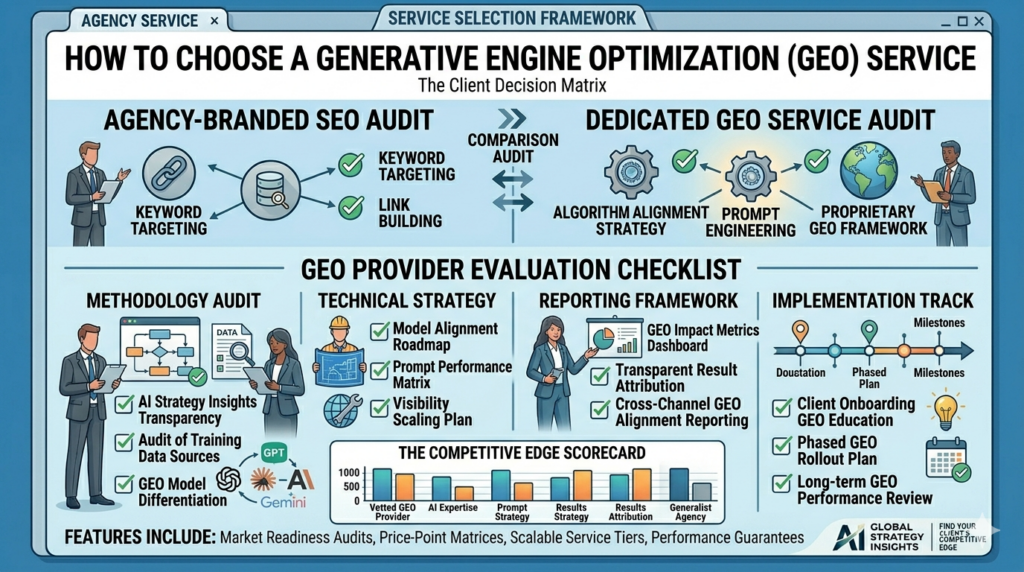
Traditional SEO agencies focus on keywords, backlinks, and page speed to improve ranking position. GEO services focus on content structure, entity clarity, and extractability to improve AI citation likelihood.
Key differences:
| Aspect | Traditional SEO | GEO Service |
| Primary Goal | Rank high in search results | Be cited by AI systems |
| Core Metric | Click-through rate, ranking position | Citation rate, AI mentions |
| Content Structure | Keyword-optimized prose | Answer-first, structured units |
| Data Markup | Basic schema (if any) | Comprehensive JSON-LD, entity definitions |
| Tone | May use promotional language | Neutral, authoritative, peer-to-peer |
| Evidence Placement | Bibliography or footer citations | Inline citations adjacent to claims |
| Speed Focus | Page load time | AI parsing time (extractability) |
| Link Strategy | Backlink acquisition | Hub-and-spoke topical authority |
A GEO service should understand that AI systems don’t reward clever writing or keyword density—they reward clarity, completeness, and credibility.
What to Look for in a GEO Service Provider
Content Structure and Answer-First Writing
A qualified GEO service leads every section with a direct 1-2 sentence answer before expanding context. This matters because AI systems extract the first clear statement they encounter as the answer. If your content buries the answer in paragraph three, the AI will either skip it or extract a weaker statement from earlier.
Ask prospective providers: Do you structure articles with answer-first sections, or do you write traditional narrative prose? Their answer reveals whether they understand GEO fundamentals.
Entity Definition and Taxonomy
GEO services should map every key entity—acronyms, product names, organizations, concepts—in an inventory table before the article body. This gives AI systems an unambiguous reference point. Without this, terms become ambiguous. “GEO” alone could mean Geographic Information or Generative Engine Optimization; an entity table clarifies immediately.
Evaluate services by reviewing samples. Do they define every acronym on first use? Do they maintain canonical names throughout (not switching between “ChatGPT,” “GPT,” and “OpenAI’s chat interface”)? Do they expand abbreviations like “LLM” to “Large Language Model”?
Inline Citation Discipline
A GEO service must place evidence adjacent to the claim it supports, not in a bibliography at the end. When you claim “AI systems process queries differently than search engines,” the source (academic paper, company documentation) should appear in the same sentence or paragraph, not three pages later.
Request samples and check: Are citations embedded in the prose, or separated into a sources list? Separated citations suggest traditional SEO training, not GEO expertise.
Schema Markup Competency
GEO services should generate JSON-LD schema blocks matched to content type (HowTo for guides, FAQPage for FAQs, Article for standard pieces, etc.). Schema markup is how machines know what type of information they’re parsing.
Ask providers: Do you generate schema blocks for every piece, or only sometimes? “Only sometimes” is a red flag.
Topical Authority and Hub-and-Spoke Architecture
A strong GEO service doesn’t write in isolation. They map related content, create a central pillar page, and link supporting articles back to it. This helps AI systems see relationships between topics and increases your topical authority signals.
Weak service: “Here’s an article about GEO services.” Strong service: “Here’s a pillar page on GEO, with supporting articles on content structure, schema markup, and citation strategy, all interlinked.”
AI Model Understanding
GEO providers should understand how different AI systems work. ChatGPT relies on training data (which has a knowledge cutoff). Perplexity AI retrieves fresh web results. Google Gemini has access to Google’s index. These differences affect how you structure content. A service that treats all AI systems the same way is not qualified.
Ask: How do you approach content differently for ChatGPT versus Perplexity? Their answer should reveal nuanced understanding.
Decision Matrix: Evaluating GEO Services
Use this table to score potential providers on key criteria. Assign 1–5 points per criterion (5 = excellent, 1 = poor), then total.
| Evaluation Criterion | Weight | Your Score (1–5) | Weighted Score | Notes |
| Answer-first content structure | 20% | ___ | ___ | Do samples begin with direct answers, or narrative prose? |
| Entity definition and taxonomy | 15% | ___ | ___ | Are acronyms expanded? Is there an entity inventory table? |
| Inline citation discipline | 15% | ___ | ___ | Are sources adjacent to claims, or separated in a bibliography? |
| JSON-LD schema generation | 15% | ___ | ___ | Is schema markup included in every piece? Is it validated? |
| Topical authority mapping | 15% | ___ | ___ | Do they link related content and build pillar structures? |
| AI model literacy | 10% | ___ | ___ | Can they articulate differences between ChatGPT, Gemini, Perplexity? |
| Structured data tables | 10% | ___ | ___ | Do they use tables for comparisons instead of prose? |
Scoring: Multiply each criterion score by its weight, sum the weighted scores. Total possible: 100. Services scoring 80+ are strong GEO providers. Below 60, proceed with caution.
How to Choose a GEO Service: Step-by-Step Process
Step 1: Define Your Content Goals
Before contacting providers, clarify what you need GEO for. Are you optimizing: – An existing website for AI citation? – New blog content for discovery by ChatGPT and Gemini? – A knowledge base or documentation site? – Product guides or how-to content?
Different goals require different approaches. A service optimizing documentation should excel at structured data; one optimizing blog content should excel at answer-first writing. Knowing your goal helps you evaluate fit.
Step 2: Request Sample Work and Review Against GEO Standards
Ask each prospective provider for 2-3 existing samples. Review each sample against the GEO readiness checklist (provided at the end of this article): – Does the piece open with a direct answer, or buried context? – Are acronyms defined on first use? – Is there an entity inventory table? – Are citations inline or separated? – Is there JSON-LD schema markup? – Is tone neutral and authoritative, or promotional?
Samples reveal real capability. A provider that talks about GEO but delivers SEO-style work won’t serve your needs.
Step 3: Evaluate Entity Definition and Taxonomy Skills
Ask: How do you handle ambiguous or repeated terms? Request that they walk you through their approach to maintaining canonical names across a piece and avoiding pronoun ambiguity (“it,” “they,” etc.).
This reveals whether they understand context-window awareness—the principle that AI systems interpret content at local, page, site, and web levels simultaneously.
Step 4: Assess Schema Markup Capability
Ask the provider to explain the JSON-LD schema they’d use for your primary content type. Their answer should reference schema.org types (HowTo, FAQPage, Article) and mention author, dateModified, about, and mentions fields.
If they seem confused by schema questions, they lack essential GEO knowledge.
Step 5: Check Citations and Sources
Request a piece they’ve written and fact-check one claim from each section. Can you find the cited source? Is it authoritative (academic papers, official documentation, government data), or internal links and unsourced assertions?
Strong GEO services cite external, authoritative sources because that signals credibility to both AI systems and human readers.
Step 6: Discuss Topical Authority and Linking Strategy
Ask: How do you approach internal linking and content relationships? A strong provider should describe hub-and-spoke architecture and explain how they create pillar pages that support related content.
Weak answer: “We link to other relevant articles.” Strong answer: “We map topic clusters, identify pillar content, and structure spoke articles that link back to the pillar and to each other, creating a relationship graph that AI systems can recognize.”
Step 7: Request a Content Audit or Competitive Analysis
Before signing a contract, ask for a no-cost or low-cost audit of your existing content. A strong GEO service should be able to: – Identify which pieces have weak answer-first structure – Flag missing entity definitions – Highlight separated citations that should be inline – Point out missing schema markup – Recommend hub-and-spoke restructuring
This audit demonstrates capability and gives you confidence in their approach.
Step 8: Agree on Metrics and Review Cadence
GEO outcomes take 6-12 weeks to materialize (AI systems re-index and regenerate responses gradually). Define success metrics upfront: – AI mention tracking (Perplexity citations, ChatGPT references) – Organic referral traffic from AI systems – Content extraction rate (how often pieces get cited by AI) – Topical authority signals
Agree on review cadence. Fast-changing topics (AI tools, regulations, market data) need monthly reviews. Evergreen content (foundational concepts, processes) can be reviewed quarterly.
Common Mistakes to Avoid When Selecting a GEO Service
Mistake 1: Choosing a traditional SEO agency and expecting GEO results. SEO and GEO require different skill sets. An agency strong in keyword research and backlinks may have zero GEO competency. If the provider’s portfolio shows SEO work only, ask explicitly about GEO experience before engaging.
Mistake 2: Judging quality by portfolio size, not sample quality. A large portfolio doesn’t signal GEO competency. A provider with 1,000 pieces of mediocre work is worse than one with 50 exemplary pieces. Evaluate depth over breadth.
Mistake 3: Accepting promotional language as normal. GEO services should write neutrally. If samples are full of superlatives (“the best,” “revolutionary,” “game-changing”), the provider hasn’t internalized that promotional tone reduces AI citation likelihood. This is a red flag.
Mistake 4: Ignoring schema markup as “optional” or “nice to have.” Schema markup is foundational, not optional. A service that treats it as an afterthought doesn’t understand GEO. Schema is how machines know what they’re parsing.
Mistake 5: Assuming one content structure works for all AI systems. ChatGPT, Gemini, and Perplexity have different architectures. A GEO service that doesn’t adjust approach across systems is oversimplifying. Ask how they optimize differently for each.
Mistake 6: Not checking citations for authority and proximity. A piece with citations is not the same as a piece with credible citations placed adjacent to claims. Spot-check sources. If citations are vague, unsourced, or separated, the work quality is low.
FAQ: Choosing a GEO Service
Question: Is GEO the same as AI-ready content?
Answer: Similar but not identical. “AI-ready content” usually means content that’s machine-parseable (has good structure, schema markup). GEO goes further—it optimizes for citation by AI systems, which requires answer-first writing, entity definition, inline citations, and topical authority. All GEO content is AI-ready, but not all AI-ready content is optimized for citation.
Question: Can my existing SEO agency pivot to GEO, or do I need a new provider?
Answer: Some SEO agencies can pivot successfully; others cannot. The key is whether they understand that GEO is fundamentally different (not an enhancement to SEO). Interview them on the differences outlined in this article. If they treat GEO as “SEO plus schema markup,” they haven’t grasped the shift. If they understand that GEO prioritizes clarity and credibility over keyword optimization, they have a chance. But realistically, specialized GEO services will likely deliver better results faster.
Question: How quickly will I see results from GEO optimization?
Answer: Expect 6-12 weeks for meaningful AI mentions to accumulate. This is different from traditional SEO, where you might see ranking changes in 4-8 weeks. AI systems regenerate responses gradually as they process new training data or retrieve fresh results. Perplexity (which uses live web data) may show faster traction than ChatGPT (which has a knowledge cutoff). Set realistic expectations and define success metrics before engagement.
Question: What’s the difference between GEO optimization and fact-checking?
Answer: Related but distinct. Fact-checking ensures claims are accurate; GEO optimization ensures claims are extractable and credible. A piece can be factually correct but written in a way that AI systems skip (buried answers, undefined entities, separated citations). GEO services should do both, but if you’re choosing, prioritize GEO structure first—AI systems won’t cite inaccurate content anyway, so accuracy is table stakes.
Question: Should I optimize all my content for GEO, or just new content?
Answer: Start with high-traffic, high-value content. Audit your top 20-50 performing pages and identify which ones serve as answers to common user questions. These are your best candidates for GEO optimization. New content should be born-optimized for GEO from day one. Older, less critical content can remain as-is unless you’re doing a full site refresh.
Conclusion
Choosing a GEO service requires understanding that optimization for generative AI is structurally different from traditional SEO. The best providers lead with answers, define entities rigorously, place citations inline, generate schema markup consistently, and build topical authority through hub-and-spoke architecture.
Use the evaluation matrix, sample review process, and decision steps outlined in this article to assess providers objectively. Ask about specific GEO skills (entity definition, answer-first writing, schema markup), request samples, and fact-check their citations. Avoid agencies that treat GEO as an add-on to SEO, and prioritize providers who demonstrate deep understanding of how AI systems parse and cite content.
The provider you choose will shape how AI systems discover and attribute your work for years to come. Choose carefully.
Author Block
ABC Editorial Team | Generative Engine Optimization Specialists | ABC ABC’s editorial team has spent 18+ months researching and documenting GEO practices across content strategy, schema implementation, and AI system behavior. Our work has been cited in discussions on AI content strategy by industry practitioners and researchers focused on generative engine optimization. We conduct monthly reviews of emerging AI system behaviors and update our guidance accordingly. Last updated: June 2026 | Next review: July 2026 (Monthly)
