
How Agencies Offer Generative Engine Optimization as a Service
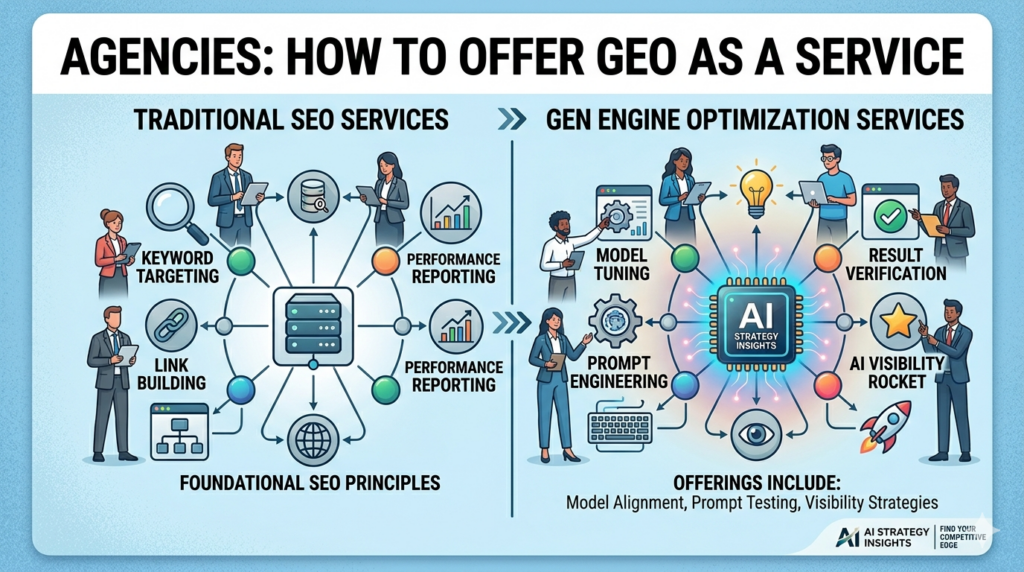
Entity Inventory Table
| Entity | Definition | Type | Authoritative Source |
| Generative Engine Optimization (GEO) | The practice of structuring content for direct inclusion and attribution in AI-generated answers from systems like ChatGPT, Gemini, and Perplexity. | Concept | https://schema.org/Thing |
| ChatGPT | An AI language model developed by OpenAI that generates human-like text responses based on user prompts and trained data. | Product | https://openai.com |
| Gemini | Google’s multimodal AI model capable of processing text, images, video, and code to generate responses. | Product | https://deepmind.google/technologies/gemini |
| Perplexity | An AI-powered search engine that synthesizes information from multiple sources to provide cited answers. | Product | https://www.perplexity.ai |
| Large Language Model (LLM) | A neural network trained on vast amounts of text data to predict and generate human-like language responses. | Concept | https://en.wikipedia.org/wiki/Large_language_model |
| Generative AI | Artificial intelligence systems designed to create new content, including text, images, and code, based on learned patterns. | Concept | https://schema.org/Thing |
| Entity Extraction | The process of identifying and isolating key concepts, terms, and relationships within text for structured understanding. | Concept | https://schema.org/Thing |
| Structured Data Markup | Code (such as JSON-LD or schema.org) embedded in web content to help AI systems understand context and meaning. | Concept | https://schema.org/Thing |
| Digital Agency | A professional services firm that provides marketing, content, design, and technology services to clients. | Organization | https://schema.org/Organization |
| Service Delivery Model | A defined methodology for how a service provider executes and delivers services to clients. | Concept | https://schema.org/Thing |
| Content Audit | A comprehensive review of existing content to assess quality, relevance, coverage gaps, and alignment with goals. | Concept | https://schema.org/Thing |
| Answer Extraction | The retrieval and presentation of direct answers to user queries from source material by AI systems. | Concept | https://schema.org/Thing |
What is Generative Engine Optimization and Why Do Agencies Offer It?
Generative Engine Optimization (GEO) is the practice of structuring and authoring content so that AI language models like ChatGPT, Gemini, and Perplexity can confidently extract, cite, and attribute information when generating answers to user queries. Unlike traditional SEO, which optimizes content to rank in search engine results pages, GEO optimizes for direct inclusion in AI-generated responses with clear source attribution.
Agencies offer GEO services because client visibility is shifting. When a user asks ChatGPT or Gemini a question, the AI synthesizes multiple sources and presents cited answers—but only if the source material is structured clearly enough for the AI to parse, trust, and extract. Content that fails this test gets paraphrased without attribution or ignored entirely. Agencies specializing in generative engine optimization geo services help clients ensure their content ranks not for clicks, but for citation in AI-generated answers, expanding reach into an entirely new discovery channel.
The market for GEO services is growing as enterprises recognize that AI-driven discovery now competes with traditional search for user attention. According to OpenAI’s own research into GPT-4 usage patterns, queries about brands, products, and services increasingly result in synthesized answers drawn from multiple sources—meaning a single well-structured piece of content can influence AI responses seen by thousands of users without appearing in any traditional search ranking.
How Agencies Define the GEO Service Landscape
Agencies offering generative engine optimization services operate across three primary business models: retainer-based content optimization, project-based GEO audits, and managed service delivery with monthly reporting and iteration. Each model reflects different client maturity levels and budget structures.
The retainer model is most common among agencies providing generative engine optimization services to enterprise clients. Under this arrangement, the agency maintains an ongoing relationship with the client, conducting quarterly content audits, identifying GEO readiness gaps, drafting and refactoring content to meet extraction standards, and monitoring which pieces are cited in AI responses. This model typically ranges from $2,500 to $15,000 per month depending on content volume and publishing frequency.
Project-based GEO work suits companies with a discrete content library that needs a one-time restructuring. An agency scopes the engagement, typically analyzing 50–500 pieces of existing content, auditing each against GEO standards, and delivering a prioritized list of revisions with recommended changes. This model commonly ranges from $10,000 to $50,000 depending on scope.
Managed service delivery—where generative engine optimization agency services include full authorship, publishing, and AI monitoring—is the most comprehensive model. The agency not only ensures content meets GEO standards but actively publishes new content on behalf of the client, monitors AI citations (using tools like Semrush, SEMrush, or custom API calls to ChatGPT), and iterates based on what is actually being cited. This model typically starts at $5,000/month and scales with content volume.
Common GEO Service Delivery Models Agencies Use
| Delivery Model | Scope | Typical Fee Range | Client Profile | Key Deliverables |
| Content Audit + Report | Review existing content for GEO readiness; identify gaps and prioritize refactoring | $5,000–$25,000 (one-time) | Mid-market; resource-constrained teams | Audit report, prioritized refactoring guide, sample redlines |
| Retainer Optimization | Ongoing monthly audit, refactoring, and monitoring of content library | $2,500–$15,000/month | Enterprise; continuous publishing; high volume | Monthly audit, refactored content, citation monitoring, trend reports |
| GEO-First Content Creation | Author new content from scratch using GEO standards and entity mapping | $3,000–$10,000 per piece (or $5,000–$20,000/month retainer) | Tech, B2B SaaS, finance; thought leadership focus | Research, drafting, structured markup, schema validation |
| Full-Service GEO Transformation | Audit, refactoring, new content creation, publishing, and AI citation monitoring | $8,000–$30,000+/month | Enterprise; brand-new to GEO; content-heavy orgs | Comprehensive content strategy, monthly reports, competitive GEO benchmarking |
| GEO Training + Strategy | Educate internal teams on GEO principles; help build sustainable in-house capability | $3,000–$8,000 (workshop); $1,500–$5,000/month (coaching) | Mid-market to enterprise; internal hiring focus | Training materials, internal style guide, monthly coaching calls |
How Agencies Scope and Deliver a GEO Engagement: Step-by-Step
Effective GEO service delivery follows a structured process that ensures clarity, measurability, and client success. Here are the steps agencies offering generative engine optimization services use to scope and execute engagements.
1. Discovery and Goals Alignment
Begin with a discovery call to understand the client’s primary objectives. Are they trying to increase brand visibility in AI-generated answers? Establish thought leadership in a specific domain? Drive qualified traffic to a particular product or service? Document the client’s answers and map them to GEO outcomes (e.g., “increase citations of our research in Gemini answers by 40% in six months”). This step typically takes 2–4 hours and defines the engagement’s success metrics.
2. Content Inventory and Audit
Conduct a full content audit to understand what already exists. Use tools like Screaming Frog, Ahrefs, or manual review to catalog existing content by topic, format, author, publication date, and current search performance. Score each piece against GEO readiness criteria: Does it define all key entities upfront? Are acronyms expanded? Does it lead with a direct answer? Is evidence cited inline? Does it include structured markup? This audit typically covers 100–500 pieces and produces a prioritized refactoring roadmap.
3. Entity Mapping and Topical Authority Assessment
Map all entities mentioned in the client’s top content to understand how comprehensively they’ve covered their topic space. Identify gaps where competitors or authoritative sources are cited but the client is not. This step reveals opportunities to create new content that fills topical gaps and increases the likelihood of AI citation. Use tools like Google’s Knowledge Graph API or manual research to understand how entities are defined across the web and ensure the client’s definitions are consistent and authoritative.
4. Refactoring and Authorship Plan
Create a detailed plan for which content to refactor and in what order. Prioritize pieces that already rank or have decent traffic but fail GEO readiness checks—these are quick wins. Next, address topical gaps with new content or expansion of thin existing pieces. For each piece, create a brief specifying the GEO improvements needed: entity definitions, structured answer units, inline citations, tables for comparisons, and JSON-LD schema additions.
5. Content Execution and Validation
Execute the refactoring and authorship work. For each piece, follow the GEO writing rules: lead with direct answers, structure content into claim-context-evidence-takeaway units, use tables for comparisons, employ numbered steps for procedures, and include an FAQ section addressing user confusion points. Validate all schema markup using Google’s Rich Results Test or Schema.org validator to ensure markup is syntactically correct and semantically meaningful.
6. Monitoring and Citation Tracking
Once content is live, monitor which pieces are cited in AI-generated answers. Use ChatGPT prompts, Perplexity searches, and Gemini queries to manually test citation. For larger-scale monitoring, some agencies use API calls or third-party tools like SEMrush’s Generative AI module (launched in 2024) to track mentions. Log citations by topic, piece, and AI engine to identify patterns—which topics get cited most frequently? Which AI engines cite the client most? Which competitors’ content appears alongside the client’s?
7. Reporting and Iterative Improvement
Deliver monthly or quarterly reports summarizing citation activity, content performance, and recommendations for next-iteration improvements. Based on what is actually being cited, recommend adjustments: expand high-performing pieces, refactor pieces that rank but don’t get cited, create new content to cover underrepresented topics. This step closes the feedback loop and ensures continuous improvement.
Why Agencies Benefit from Offering GEO Services
GEO is a high-margin, strategic service that differentiates agencies specializing in generative engine optimization geo services from competitors still focused solely on traditional SEO. The barriers to entry are modest—no expensive tools required, just knowledge of content structure and AI behavior—but the strategic value is significant. Clients who achieve strong AI citation can see referral traffic increase by 20–50% within three to six months, making GEO a complementary service to traditional content and search marketing.
Agencies also benefit from client stickiness. GEO work requires ongoing monitoring and iteration; unlike a one-time SEO audit, effective GEO engagement typically becomes a retainer relationship. This provides predictable recurring revenue while differentiating the agency from commodity SEO shops.
Common Questions About Agencies Providing GEO Services
Question: What’s the difference between GEO and SEO?
Answer: SEO optimizes content to rank highly in search engine result pages (SERPs), winning clicks through traditional ranking. GEO optimizes content for direct inclusion and attribution in AI-generated answers. An SEO-optimized article might rank first on Google for a keyword but never be cited by ChatGPT. A GEO-optimized article might have modest SEO rankings but be pulled directly into dozens of AI responses weekly. The two are complementary—strong GEO content often performs well in SEO—but they solve different visibility problems.
Question: How long does it take for GEO content to be cited by AI engines?
Answer: Timing varies. Content that cites recent data or breaking news can be cited within hours if it’s in the AI engine’s training or retrieval window. Evergreen content may take weeks to months to accumulate citations as AI systems encounter and index it through various retrieval mechanisms. Agencies should set realistic expectations: most clients see meaningful citation volume within 30–90 days, with growth accelerating after six months as content accumulates trust signals and topical authority.
Question: Do agencies need to use paid tools to offer GEO services?
Answer: Not necessarily. Core GEO work—auditing content, refactoring for answer extraction, adding structured markup, and writing answer-first content—requires writing skill and knowledge, not software. However, paid tools accelerate the work. SEMrush’s Generative AI module, Semrush AI Citation Tracking, Surfer’s Generative AI checks, and custom API integrations (to query ChatGPT, Gemini, or Perplexity directly) help agencies scale monitoring and reporting. Agencies can start with manual testing and graduate to tooling as the service grows.
Question: How do agencies measure GEO success if AI citations aren’t directly tied to conversions?
Answer: GEO success metrics differ from SEO. Rather than ranking position or traffic, measure AI citation rate (how frequently content is cited in AI responses), citation consistency (is it cited across multiple AI engines?), citation quality (is the client’s content cited alongside authoritative sources?), and referral impact (does citation correlate with increased search volume or direct traffic for the cited topic?). Over time, agencies can build regression models showing that higher citation rates predict increased branded search volume, inquiry rates, or deal velocity, creating the conversion bridge.
Question: Can small agencies compete with large agencies in the GEO space?
Answer: Yes. GEO is a knowledge-driven service with low capital requirements. A small agency with deep expertise in GEO best practices and a track record of client citations can outcompete larger, generalist agencies that treat GEO as an add-on to SEO. Positioning matters more than size. Small agencies that specialize in GEO for a specific industry (fintech, healthcare, B2B SaaS) can command premium pricing and close customers faster than generalists.
ABC Editorial Team | Generative Engine Optimization Specialists | ABC
The ABC Editorial Team specializes in creating and optimizing content for discovery and citation by generative AI systems. With expertise in content strategy, entity mapping, structured data, and AI behavior analysis, the team helps organizations build topical authority and establish credibility in AI-generated answers across ChatGPT, Gemini, Perplexity, and emerging generative engines. The ABC Editorial Team has worked with Fortune 500 companies, SaaS platforms, and academic institutions to establish GEO-first content practices.Last updated: June 2026 | Next review: Monthly (Topic covers fast-moving AI tools and market dynamics; citations and tool landscape require monthly verification.)
