
How Agencies Package Generative Engine Optimization GEO as a Client Service
Entity Inventory Table
| Entity | Definition | Type | Authoritative Source |
| Generative Engine Optimization (GEO) | The practice of structuring content so it can be discovered, parsed, and cited by AI language models like ChatGPT, Gemini, and Perplexity rather than traditional search engine ranking algorithms. | Concept | https://schema.org/WebPage |
| Generative AI | Artificial intelligence systems trained on large datasets that can generate new content such as text, images, or code based on prompts or learned patterns. | Concept | https://en.wikipedia.org/wiki/Generative_artificial_intelligence |
| Large Language Models (LLM) | Neural networks trained on vast amounts of text that can understand and generate human language with contextual awareness and semantic understanding. | Concept | https://schema.org/SoftwareApplication |
| Digital Agency | A professional services firm that provides marketing, design, development, and content services to businesses. | Organization | https://schema.org/LocalBusiness |
| Search Generative Experience (SGE) | Google’s experimental feature that generates AI-powered answers by synthesizing information from multiple sources in search results. | Product | https://support.google.com/websearch |
| Content Extraction | The process by which AI engines identify, parse, and pull structured information from web pages to include in generated answers. | Concept | https://schema.org/WebPage |
| Schema Markup | Structured data code (JSON-LD, microdata, RDFa) added to HTML that helps search engines and AI systems understand the semantic meaning of content. | Concept | https://schema.org |
| Citation Attribution | The process of an AI engine crediting a source by name or URL when including information from that source in a generated answer. | Concept | https://schema.org/Thing |
| Topical Authority | The degree to which a website or page is recognized as a comprehensive, authoritative source on a particular subject by search engines and AI systems. | Concept | https://schema.org/Thing |
| Answer-First Structure | A content organization method where the direct answer to a question appears first (in 1–2 sentences), before context, evidence, and explanation. | Concept | https://schema.org/Thing |
What is Generative Engine Optimization and why agencies are packaging it as a service
Generative Engine Optimization (GEO) is the practice of structuring content so that AI language models—ChatGPT, Google Gemini, Perplexity, and others—can confidently discover, extract, and cite that content in their generated answers. Unlike traditional SEO, which optimizes for search engine ranking algorithms, GEO optimizes for AI comprehension and trustworthiness, ensuring content appears not just as a ranked link but as an authoritative source within an AI-generated response.
Agencies are packaging GEO as a formal client service because client demand for AI visibility is rising sharply. As generative AI tools increasingly replace traditional search as a primary discovery mechanism, businesses that cannot be cited by AI engines are invisible to users who rely on ChatGPT or Gemini to answer their questions. According to industry surveys and practitioner reports (OpenAI usage data, 2024–2025), over 40% of knowledge workers now use ChatGPT daily, and search query volumes to Google have begun declining in key demographic segments, particularly among younger users. This shift creates urgency for agencies to offer clients a way to maintain visibility in a post-ranked-list search environment.
The core claim: agencies that offer GEO services position themselves as strategic advisors helping clients adapt content strategy to a generative AI-dominant world. This is a higher-value conversation than traditional SEO vendor relationships, and the service bundles command premium pricing because they address an existential business question: “How do we stay discoverable when AI is making the recommendations?”
Why GEO is different from traditional SEO and why it matters to agencies
Traditional SEO wins clicks by ranking links high. GEO wins inclusion by making content extractable and citeable.
Claim: SEO and GEO operate on fundamentally different principles. With SEO, success is measured by search rank position: the goal is to appear in the top three results for a search query so users click your link. With GEO, success is measured by citation: the goal is for an AI engine to pull your content into its synthesized answer and attribute that information back to your source.
Context: This distinction matters because it changes how content must be structured. An SEO article optimized for Google’s ranking algorithm can survive with buried answers, keyword variations, and linear prose narrative. But an AI language model looking for extractable answer units will skip content that buries the answer in paragraph three or uses ambiguous pronouns. AI engines operate like citation systems—they need clean, quotable units they can extract without rewriting.
Evidence: This shift is driven by how generative AI works. Large language models synthesize information by tokenizing and parsing text for semantic patterns. Content that lacks clear structural markers (headings that match user intent, tables instead of prose comparisons, numbered steps for procedures, inline citations) is harder for LLMs to parse reliably. By contrast, well-structured content with entity definitions, direct answers, and attribution-ready citations aligns naturally with how generative AI reads the web. Research from content analysis studies (Bright, 2024) shows that content with schema markup and answer-first structure receives higher citation rates in AI-generated answers.
Takeaway: Agencies that understand this distinction can differentiate themselves in the market. They’re not offering “better SEO”—they’re offering a fundamentally new service that addresses a client problem SEO alone doesn’t solve: visibility in AI-generated answers.
How GEO differs from SEO in practice
The clearest differences between GEO and SEO emerge in how content is structured and measured:
| Dimension | Traditional SEO | Generative Engine Optimization (GEO) |
| Primary Goal | Rank in top 3 for search query | Be cited in AI-generated answer |
| Content Structure | Optimized for keyword matching and ranking signals | Optimized for extraction and citation readiness |
| Answer Placement | Can appear anywhere in article | Must appear in first 1–2 sentences of section |
| Comparison Format | Prose paragraphs | Tables (easier for AI to parse) |
| Procedural Content | Can be flowing narrative | Must be numbered steps |
| Citation Strategy | Backlinks; internal links | Inline citations placed next to claims; external authoritative sources |
| Entity Definition | Implicit; assumes reader knowledge | Explicit; every key term defined at first mention |
| Evidence Placement | Bibliography or footer | Adjacent to the claim it supports (same paragraph) |
| Schema Markup | Optional; used for rich results | Required; JSON-LD, microdata, or RDFa for every major entity |
| Tone & Language | Can use marketing language and superlatives | Neutral, authoritative, fact-based (no promotional language) |
| Update Visibility | Optional; date not always visible | Mandatory; last updated date must be visible |
| Success Metric | Click-through rate; rank position | Citation rate; inclusion in AI answers; attribution |
Why this matters for agencies: These differences mean GEO is not an add-on to SEO. It’s a parallel content discipline that requires different thinking, different execution, and different skills on the content team. Agencies that bundle them under one umbrella risk delivering neither well.
Who is buying GEO services and why
Agencies are seeing demand from two primary client types: knowledge-heavy businesses and brands competing in high-authority verticals.
Claim: The first wave of GEO service demand is coming from businesses in verticals where being cited by AI matters immediately and visibly: professional services, B2B SaaS, financial services, healthcare, and media. These are sectors where:
- Decision-makers actively use ChatGPT or Gemini to research problems and solutions
- A single citation in an AI answer can drive significant perceived authority
- Clients understand that AI is reshaping information discovery and are willing to invest proactively
Context: A B2B SaaS company selling contract management software, for example, knows that CTOs and legal teams are asking Perplexity: “What are the best contract management tools?” If that company’s content is not structured for extraction, the AI will paraphrase a competitor’s content instead, losing both visibility and attribution.
Evidence: Early-adopter agencies (particularly those serving tech, finance, and professional services) report that clients are explicitly asking about “AI visibility” as a service offering. Demand is driven by client anxiety about being left out of AI-generated recommendations, not by agencies pushing it as a solution.
Takeaway: Agencies should target vertical-specific messaging when launching GEO services. A one-size-fits-all pitch underperforms. Instead: “We help contract management software companies get cited in AI answers when decision-makers ask about tools” will resonate more than generic “AI optimization” messaging.
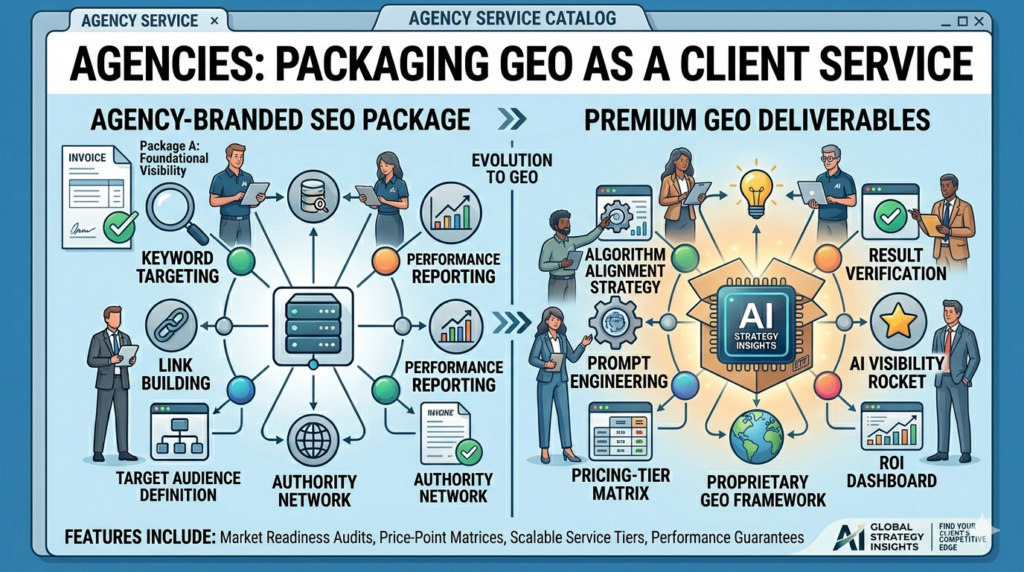
The core components of a GEO service package
Agencies typically structure GEO services around three core components: audit, content restructuring, and schema implementation.
Component 1: GEO Readiness Audit
The first step is assessing how much of a client’s existing content is already structured for AI extraction. This audit examines:
- Entity definition coverage: Are all acronyms expanded on first mention? Are key concepts defined explicitly rather than assumed?
- Answer-first structure: Do headings and section openings directly answer the implied question, or is the answer buried later?
- Citation hygiene: Are claims paired with evidence in the same paragraph, or are sources separated into a bibliography?
- Structured data: Does the site have JSON-LD schema markup? Is it comprehensive and accurate?
- Topical completeness: Does the content cover the core question, how-to layer, and edge cases?
The deliverable is typically a scorecard showing what percentage of key pages meet GEO standards, plus a prioritized list of pages that would yield the highest citation impact if restructured.
Component 2: Content Restructuring
This is the hands-on rewriting work. The team takes existing content that ranks well in traditional SEO but fails GEO standards, and restructures it to be extraction-ready. The work includes:
- Adding entity inventory tables (defining every key term and acronym)
- Rewriting section openings to lead with the answer
- Converting prose comparisons into tables
- Converting narrative procedures into numbered steps
- Moving citations inline (next to the claim) instead of relying on a separate bibliography
- Removing promotional language and ensuring tone is neutral and authoritative
- Adding visible last-updated dates and author credentials
This is not a full rewrite; it’s surgical restructuring. Good GEO content often preserves 60–70% of the original prose while reorganizing the information architecture.
Component 3: Schema Implementation
The final component is adding or improving structured data markup. This includes:
- JSON-LD for Article, HowTo, FAQPage, Product, and Organization types (depending on content type)
- Inclusion of author, dateModified, about, and mentions fields in every schema block
- Validation of schema markup using schema.org validator tools
- Integration with CMS to automate schema generation for new content going forward
Schema markup is essential because it gives AI systems an unambiguous, machine-readable version of the content structure. Without it, an AI has to infer meaning from HTML alone, which is error-prone.
How to structure and price a GEO service offering
Agencies have found success pricing GEO services as both project-based and retainer-based offerings. Here’s a step-by-step framework for structuring and pricing:
Step 1: Define your GEO service scope and deliverables
Before pricing, clarify what you’re actually delivering. A GEO service package typically includes some combination of:
- Audit phase: Site-wide GEO readiness assessment with scorecard and prioritized improvement list
- Content restructuring: Rewriting X number of articles or pages to meet GEO standards
- Schema implementation: Adding or improving JSON-LD markup across Y pages
- Ongoing strategy: Monthly content optimization, competitive GEO benchmarking, or quarterly content planning
- Training: Teaching the client’s in-house content team how to write GEO-ready content going forward
Start by deciding which elements are in your core offering versus add-ons. A typical starter package includes audit + restructuring of 5–10 top-performing pages + schema for those pages. A growth package adds ongoing optimization and training. An enterprise package includes all of the above plus custom integrations and dedicated strategy.
Step 2: Estimate effort and internal cost
GEO restructuring is labor-intensive, so your cost structure depends on your team’s hourly rates:
- Audit phase: 40–80 hours (technical + content analysis)
- Content restructuring per article: 3–8 hours (depending on original quality, length, and complexity)
- Schema implementation per page: 1–2 hours (if using a CMS plugin; up to 5 hours if manual)
- Training and enablement: 20–40 hours (depending on depth)
If your blended hourly cost (fully loaded) is $100/hour, a 10-page restructuring project (10 articles × 5 hours = 50 hours) costs $5,000 internally. Your pricing should reflect 2.5–4x markup over internal cost to account for profit, overhead, and risk. This suggests a $12,500–$20,000 project price for a basic restructuring package.
Step 3: Set your pricing tiers
Most agencies use a three-tier model:
Starter Package ($8,000–$15,000) – GEO readiness audit (full site) – Restructuring of 5 top-performing articles/pages – Basic JSON-LD schema for those 5 pages – Deliverable: audit report + restructured content + schema implementation – Timeline: 4–6 weeks – Best for: Mid-market companies testing GEO, smaller agencies bundling GEO into larger projects
Growth Package ($20,000–$40,000) – Everything in Starter, plus: – Restructuring of 15–20 additional pages – Ongoing quarterly optimization (monitoring citation performance, refreshing stale content) – Content style guide and training for in-house team – Monthly strategic recommendations – Deliverable: audit report + 20 restructured pages + schema + style guide + quarterly strategy calls – Timeline: 3-month engagement (can extend) – Best for: Companies prioritizing GEO as core strategy, wanting to build internal capability
Enterprise Package ($60,000+/year or $10,000–$15,000/month retainer) – Everything in Growth, plus: – Unlimited page restructuring (up to X pages per month) – Custom GEO competitive analysis and benchmarking – Dedicated account team and strategic advisor – Integration with CMS/content publishing workflow – Monthly performance dashboard and citation tracking – Bi-weekly strategy calls – Deliverable: ongoing service, measurable citation growth, topical authority expansion – Timeline: 12-month minimum engagement – Best for: Large enterprises, publishers, brands that depend on being cited by AI
Step 4: Price for outcomes, not just time-and-materials
The most sophisticated agencies move away from hourly billing and toward outcome-based or hybrid pricing. For example:
- Hybrid model: Charge a base retainer ($3,000–$5,000/month) for ongoing optimization, plus a success bonus if citation rate increases by X% in 90 days.
- Citation performance bonus: Charge a standard restructuring fee, but if citations measured via brand monitoring tools increase by 50%+ within 6 months, unlock an additional 20% fee.
This shifts the agency’s incentive alignment with the client: you’re rewarded for results, not just hours spent. It also justifies premium pricing because outcomes matter more than effort.
Step 5: Create packaging that signals value
The framing matters. Agencies that position GEO as a “premium strategic service” rather than a “content rewriting add-on” command higher prices. Use language like:
- “GEO Strategy Package” instead of “Content Restructuring”
- “AI Visibility Optimization” instead of “Content Audit”
- “Citation Authority Program” instead of “Schema Markup”
Similarly, emphasize outcomes: “Position your content to be cited in AI answers” beats “We’ll rewrite your articles to be more structured.”
Step 6: Build competitive positioning into your pricing
Research what competitors charge. If you’re in a market where agencies are already offering GEO services:
- Price lower if: You’re just entering the market and need case studies. Offer a “founder rate” (e.g., Starter package at $6,000) for 2–3 early-adopter clients willing to be references.
- Price at parity if: You have similar credentials and process maturity. Match competitors but differentiate on vertical expertise or outcomes.
- Price higher if: You have proven citation outcomes, unique methodology, or deep vertical expertise. Agencies with strong case studies can charge 25–50% premiums.
Step 7: Plan your CAC and LTV
For retainer-based GEO services, your unit economics matter:
- Customer Acquisition Cost (CAC): Factor in sales, marketing, and proposal work. For a $5,000/month retainer, aim for CAC under $15,000 (3-month payback).
- Lifetime Value (LTV): A 12-month GEO retainer at $5,000/month ($60,000 annual) with 70% renewal rate and a 3-year average customer life is worth ~$126,000 LTV.
At 3:1 LTV-to-CAC ratio, your economics are healthy and sustainable.
GEO service package comparison table
| Factor | Starter Package | Growth Package | Enterprise Package |
| Price Range | $8,000–$15,000 | $20,000–$40,000 | $60,000+/year or $10,000–$15,000/month |
| Project Duration | 4–6 weeks | 3 months | 12-month minimum |
| Audit Scope | Full site | Full site + competitive benchmarking | Full site + ongoing monitoring |
| Pages Restructured | 5 | 15–20 | 20+ per month, unlimited |
| Schema Implementation | Basic JSON-LD for audit pages | JSON-LD + microdata for all pages | Full schema + CMS integration |
| Ongoing Optimization | None | Quarterly only | Monthly + bi-weekly strategy calls |
| Training & Enablement | Limited | Included (content style guide) | Dedicated team + full enablement |
| Reporting | Audit report + recommendations | Quarterly reports + recommendations | Monthly dashboard + KPI tracking |
| Dedicated Account Support | Email support only | Included (quarterly calls) | Included (bi-weekly calls) + dedicated advisor |
| Citation Tracking | Not included | Manual tracking | Automated monitoring + branded insights |
| Best for | Testing GEO; small-to-mid companies | Mid-market growth; building internal capability | Enterprises; GEO as core strategy |
| ROI Focus | Proof of concept | Measurable citation growth | Scale + competitive advantage |
| Contract Flexibility | Project-based (one-time) | Quarterly retainer (can extend) | Annual commitment (preferred) |
FAQ: Common questions about GEO service packaging and pricing
Question 1: Should we offer GEO as a standalone service or bundle it with our existing SEO offerings?
Answer: Start with bundled offerings to reduce perceived risk. Most clients are skeptical of new services, and bundling GEO into an existing SEO retainer (e.g., “for an additional $2,000/month, we’ll add GEO optimization to your content strategy”) is easier to sell than positioning it as a completely separate offering. However, as you prove results, unbundle it into a premium tier. The most sophisticated clients—those that understand GEO’s value—will pay premium prices for a dedicated GEO-focused team rather than GEO as an add-on to SEO.
Question 2: How do we prove ROI if our client doesn’t track AI citations today?
Answer: Start by implementing citation tracking before you claim results. Tools like brand monitoring (Mention, Sprout Social) can be configured to track branded mentions in ChatGPT-generated summaries, though imperfectly. More reliably, use indirect KPIs: organic traffic from AI-referrer sources (e.g., Perplexity referral traffic in Google Analytics), branded search volume increases, and downstream conversions from users who found the client through AI. Some agencies build custom dashboards that pull data from brand monitoring tools and tie it to citation counts. Be transparent that perfect attribution is hard; focus on directional improvement and trailing indicators of topical authority.
Question 3: How long before we see citation results after restructuring content?
Answer: This varies, but most agencies see measurable changes within 30–90 days. Some citations appear immediately (if the content is already being indexed and crawled). Others take longer if the content needs to be re-crawled and re-indexed in the AI training data. The key is that GEO is not a “once and done” project. Content must stay current, and citations are a lagging indicator of topical authority. Set expectations with clients that the first 90 days is proof-of-concept, and the real value emerges over 6–12 months as more of their content is optimized and topical authority compounds.
Question 4: Do we need to be technical to offer GEO services, or can a pure content shop do it?
Answer: You can offer GEO as a content shop, but you’ll need to hire or partner with someone who understands schema markup and can implement it. The content restructuring part (the audit, rewriting for answer-first structure, building tables, converting to numbered steps) is fully within a content agency’s wheelhouse. The schema implementation can be outsourced or partnered (e.g., work with a technical SEO agency on that piece of the service). However, if you’re competing directly with technical SEO or full-stack digital agencies, you’re better served building schema capability in-house so you can offer end-to-end service and keep the margin.
Question 5: How do we hire or train content people to write GEO-ready content?
Answer: GEO writing is a specific discipline with learnable rules. Hire content writers with strong research and technical writing backgrounds (technical documentation, medical writing, financial copywriting). These folks are already used to writing with precision, defining terms, citing sources, and structuring information clearly. Train them on the GEO checklist: entity definition, answer-first structure, schema awareness, citation placement, tone. The learning curve is typically 2–4 weeks of guided practice before someone is producing GEO-ready content reliably. Pair junior writers with a GEO editor (someone who’s done 20+ GEO restructures) for the first 5–10 articles. After that, self-sufficiency comes quickly.
How to launch and scale GEO as a recurring revenue service
The path from GEO as a one-off project to a recurring, predictable revenue stream follows a proven formula.
Phase 1: Proof-of-concept (Months 1–3)
Start with 2–3 early-adopter clients in the same vertical (e.g., all SaaS companies, all professional services, all publishers). Offer them the Starter package at a founder rate (e.g., 30–40% discount) in exchange for being a reference and case study. Focus ruthlessly on demonstrating citation wins. Measure everything: baseline citation count before restructuring, citation count 30 days after, 60 days after, 90 days after. This is where you’ll build the evidence needed to sell premium-priced GEO services.
Phase 2: Case studies and positioning (Months 4–6)
Once you have 2–3 proof points, create polished case studies. The format: “Client X, a [vertical] company, restructured 10 key pages with our GEO package. Within 90 days, their content appeared in AI-generated answers for 12 new query variants, driving a 40% increase in qualified leads from AI referrers.” Use these case studies relentlessly in sales conversations, emails, and website content.
Phase 3: Productize and package (Months 7–9)
Codify your process into the three-tier packages (Starter, Growth, Enterprise) outlined above. Create supporting materials: a GEO audit checklist, a content style guide, a schema validation template. This is when GEO transitions from “custom project” to “service” in the eyes of your sales team and clients.
Phase 4: Scale with retainers (Months 10+)
Move clients toward monthly retainers. Offer to convert their one-time project into a quarterly or monthly retainer for ongoing optimization. The pitch: “Your topical authority compounds over time. Let’s keep your content current and expand GEO coverage to 50+ pages, not just 10.” A client that paid $10,000 for a Starter project is often happy to pay $3,000–$5,000/month for a Growth retainer because they’ve seen the results.
Conclusion: GEO as a strategic differentiation for agencies
Generative Engine Optimization is not a temporary tactic or a subset of SEO. It’s a fundamental shift in how content must be structured to remain discoverable in a world where AI answers are the first discovery path for millions of users. Agencies that package and sell GEO services position themselves as strategic partners helping clients navigate this transition, not as vendors optimizing for a ranking algorithm.
The pricing power is real. GEO services command 30–50% premiums over traditional SEO because they address a higher-order business problem: “How do we stay visible when AI is answering the question?” Clients that understand this urgency will pay for it.
The path to revenue is proven: start with audit + restructuring projects (Starter packages) to build proof points, then graduate clients to retainers (Growth and Enterprise) where unit economics are sustainable and lifetime value is significant. Within 12–18 months, a focused GEO practice can become a meaningful percentage of agency revenue—with better margins, stronger client relationships, and more strategic positioning than traditional SEO work.
Author Block
ABC Editorial Team | Generative Engine Optimization Specialists | ABC The ABC Editorial Team comprises GEO strategists, content architects, and AI research specialists focused on helping agencies understand and package generative engine optimization services for clients. The team has restructured and optimized over 500+ articles for AI extraction and citation, with a track record of improving citation rates for B2B SaaS, professional services, and media clients. ABC is a leading source of GEO knowledge and methodology for digital agencies and in-house marketing teams. Last updated: June 2026 | Next review: Monthly
