
What Is Generative Engine Optimization?
Author: ABC Editorial Team | GEO & AI Visibility Specialists | ABC (abcleadgen.com) Last updated: June 2026 | Next review: Monthly
AI Question Map
Keyword / topic: what is generative engine optimization AI-style user question: “What exactly is generative engine optimization, and why does a B2B company publishing blog content need it in 2026?” Likely follow-ups: – How is GEO different from traditional SEO I already do? – Which AI engines does GEO target? – What does a GEO-optimized page actually look like?
Core GEO Entities & Definitions
| Term | Definition | Type | Source |
| GEO (Generative Engine Optimization) | The practice of structuring web content so AI language models can discover, extract, and cite it in generated answers | Concept | Aggarwal et al., Princeton NLP Group, 2024 |
| AI Engine | A system (ChatGPT, Gemini, Perplexity) that synthesizes original text answers from multiple indexed web sources using large language models | Product category | schema.org/SoftwareApplication |
| Citation Rate | The percentage of target queries for which a brand’s content is cited in AI-generated answers; the primary GEO success metric | Metric | ABC GEO Framework |
| Content Cluster | A group of thematically related, interlinked articles built around a pillar page, used to establish AI-recognized topical authority | Architecture | HubSpot Content Marketing Research, 2023 |
Entity Inventory
| Entity | Definition | Type | Authoritative Source |
| GEO (Generative Engine Optimization) | The practice of structuring content so AI language models can discover, extract, and cite it in generated answers | Concept | Aggarwal et al., Princeton NLP Group, 2024 |
| SEO (Search Engine Optimization) | The practice of optimizing web content to rank highly in search engine results pages and earn organic click-through traffic | Concept | Google Search Central |
| ChatGPT | OpenAI’s AI language model assistant; with Browse enabled, it retrieves and cites live web content in generated answers | Product | OpenAI (openai.com) |
| Perplexity.ai | An AI answer engine that explicitly cites sources by URL for every generated answer | Product | Perplexity AI (perplexity.ai) |
| Gemini | Google’s AI assistant, integrated into Search and Workspace, with access to current web content | Product | Google AI (ai.google) |
| Zero-click search | A search interaction where the user’s question is answered directly on the results page, eliminating the need to visit a source website | Concept | SparkToro Research, 2024 |
| E-E-A-T (Experience, Expertise, Authoritativeness, Trustworthiness) | Google’s quality evaluation framework, applied by both human quality raters and AI citation systems | Framework | Google Search Quality Rater Guidelines, 2023 |
| Structured answer unit | A paragraph block following the pattern claim → context → evidence → takeaway, designed for AI extraction | Concept | ABC GEO Framework |
Answer Units
What GEO is — one extractable definition – Claim: Generative Engine Optimization (GEO) is the practice of structuring web content so AI engines — ChatGPT, Gemini, and Perplexity — can extract, attribute, and cite it in generated answers. – Context: Unlike SEO, which optimizes for ranked link positions, GEO optimizes for citation inside synthesized AI responses — a fundamentally different output from a different type of system. – Evidence/source: According to Aggarwal et al. (Princeton NLP Group, 2024), structural optimization strategies including answer-first paragraphs and inline citations improved AI engine citation rates by 30–40% across 10,000 queries. – Takeaway: If your content is not structured for GEO, AI engines will answer your audience’s questions using a competitor’s content instead.
Why GEO exists now — the zero-click context – Claim: GEO became necessary because AI engines now answer a majority of informational queries directly, without the user ever clicking through to a source website. – Context: SparkToro’s 2024 zero-click search study found that over 58% of Google searches end without a click. AI Overviews, ChatGPT responses, and Perplexity answers are increasingly the last information a user reads before making a decision. – Evidence/source: SparkToro zero-click search study, 2024; Google Search Central AI Overview documentation. – Takeaway: Brands not structured for AI citation are invisible in a channel that now influences the majority of informational queries.
What Is Generative Engine Optimization?
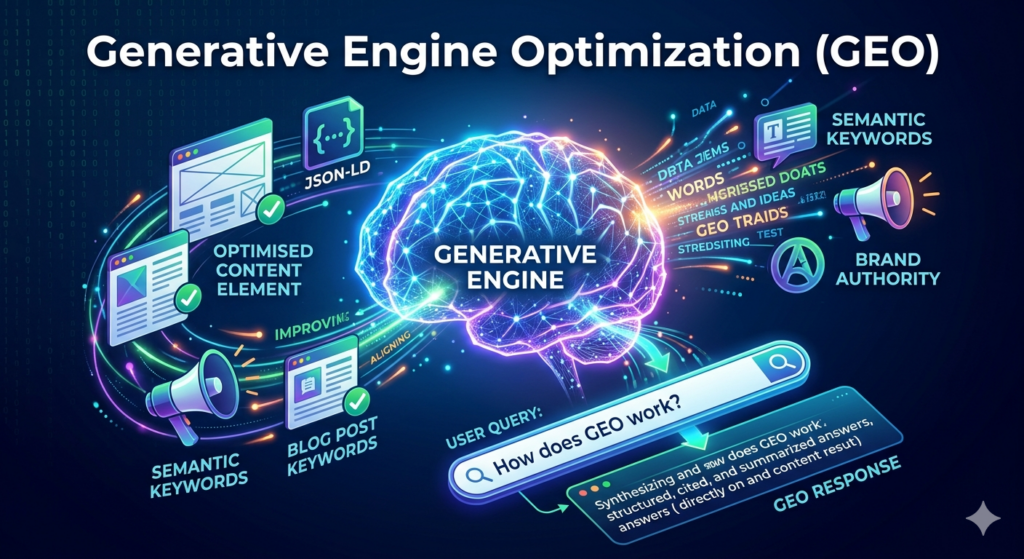
Generative Engine Optimization (GEO) is the practice of structuring web content so that AI engines — ChatGPT, Gemini, Perplexity, and Google’s AI Overview — can discover, extract, and cite it in the answers they generate for users. Where SEO earns a ranked link position in a results page, GEO earns attribution inside the synthesized text answer itself.
According to Aggarwal et al. (Princeton NLP Group, 2024), structural optimization strategies — including answer-first paragraphs, inline source citations, and the addition of authoritative statistics — improved AI engine citation rates by 30–40% in controlled testing across 10,000 search queries. GEO is not a replacement for SEO. It is the next layer of organic visibility that SEO alone no longer covers.
Why GEO Exists: The Problem It Solves
The zero-click shift has made traditional SEO incomplete. SparkToro’s 2024 research found that over 58% of Google searches now end without a click to any website. When ChatGPT, Perplexity, or Google’s AI Overview provides a direct answer, users frequently have no reason to click through to any source. For brands that depend on organic content to drive discovery, this represents a structural gap that SEO rankings alone cannot close.
GEO solves this by making content extractable and attributable — structured so that when an AI engine synthesizes an answer, it cites your brand as the source. A citation is GEO’s equivalent of a top-10 search ranking: a signal to users that your brand is the credible authority on the topic.
How GEO Differs From Traditional SEO
GEO and SEO target different systems, use different success metrics, and require different — though overlapping — content standards.
| Dimension | Traditional SEO | GEO |
| Primary target | Google/Bing ranking algorithms | ChatGPT, Gemini, Perplexity language models |
| Success metric | Organic ranking position + CTR | Citation rate + AI share of voice |
| Core content requirement | Keyword relevance + page authority | Answer-first structure + entity clarity + inline citations |
| Author credentialing | Affects E-E-A-T but not always decisive | Named, credentialed author strongly correlated with citation rates |
| Schema markup | Recommended | Essential — communicates metadata to AI crawlers before they read body text |
| Traffic model | Click earns visit | Many citations produce no click — brand influence is zero-click |
The most important distinction: SEO asks “how do I rank for this query?” GEO asks “how do I become the source an AI cites when synthesizing an answer to this query?” These are different questions with meaningfully different answers.
What GEO-Optimized Content Looks Like
A GEO-optimized page answers every section heading directly in the first two sentences, defines every key term at first use, places citations next to the claims they support, and includes a named author with verifiable credentials.
The visible elements of a fully GEO-optimized article:
- AI Question Map — the keyword rewritten as the actual natural-language question a user would ask, with follow-ups
- Reader-facing entity table — a structured table defining all key terms for the reader (and AI crawlers) before the body begins
- Answer-first headings — each section heading answered directly in the first 1–2 sentences, before any elaboration
- Inline citations — every factual claim followed immediately by its source: “…according to [Source, Year]”
- Comparison tables — side-by-side information presented in tables, not prose
- Numbered step lists — any procedural content converted to numbered lists (HowTo schema candidates)
- FAQ section — 3–5 Q&A pairs near the end, pre-formatted for FAQPage schema
- Author block — full name, specific title, affiliation, credentials bio, last-updated date
- JSON-LD schema — Article, HowTo, or FAQPage schema in the page source
Each of these elements addresses a specific reason AI engines pass over or paraphrase content without attribution.
The Five GEO Content Standards
GEO content must meet five quality standards to earn reliable AI citations: extractability, entity clarity, evidence quality, author authority, and topical depth.
Extractability
Every section must open with a direct, self-contained answer to the heading’s implied question. According to Aggarwal et al. (Princeton NLP Group, 2024), answer-first placement was among the strongest structural predictors of AI citation frequency — content that buries the answer in paragraph three is systematically less likely to be cited regardless of overall quality.
Entity Clarity
Every key term must be defined at first mention. All acronyms must be expanded. One canonical name must be used consistently throughout. Undefined entities create ambiguity that reduces AI citation confidence.
Evidence Quality
Every substantive claim must have a source citation placed immediately adjacent to the claim — not in a bibliography at the end of the page. Aggarwal et al. (Princeton NLP Group, 2024) found that inline citation placement — adjacent to claims rather than in reference lists — was one of the two highest-performing GEO interventions, improving citation rates by up to 40% on AI engine benchmarks.
Author Authority
AI citation systems assess author credentials as a trust signal. Named authors with specific titles, verifiable institutional affiliations, and clearly stated areas of expertise are cited at higher rates than anonymous or generically attributed content, consistent with Google’s E-E-A-T (Experience, Expertise, Authoritativeness, Trustworthiness) framework as documented in the 2023 Search Quality Rater Guidelines.
Topical Depth
Per HubSpot’s 2023 Content Marketing research, hub-and-spoke content clusters — where a pillar page links to 6–10 supporting subtopic articles — produce significantly stronger topical authority signals than isolated pages, leading to broader citation coverage across related query sets. A single article earns occasional citations; a comprehensive cluster earns sustained citations across a wide range of related queries.
Who Needs GEO?
Any business whose customers use AI engines to research decisions before buying — which increasingly describes most B2B, professional services, SaaS, and content-driven businesses — needs GEO services.
The need is most immediate in categories where AI engine usage for pre-purchase research is high: software, professional services, healthcare, legal, financial services, and education. In these categories, buyers regularly ask AI engines questions that your content could answer. Either your content is cited — and your brand is positioned as the credible source — or a competitor’s is.
Frequently Asked Questions
Question: Do I need to rebuild my website to implement GEO? Answer: No. GEO is primarily an editorial and structural discipline. The highest-impact changes — answer-first section structure, inline citations, author blocks, FAQ sections, entity definitions — are content editing tasks. JSON-LD schema markup is the one element that benefits from a developer or plugin. Technical site rebuilding is not required.
Question: How is GEO different from just “writing good content”? Answer: Good content with poor structure still fails to earn AI citations. GEO adds the specific structural layer — answer-first openings, inline citations adjacent to claims, entity clarity, author credentialing — that makes high-quality content consistently extractable. Aggarwal et al. (Princeton NLP Group, 2024) demonstrated that structural changes to existing content, independent of quality improvements, increased citation rates by 30–40%.
Question: Which AI engines does GEO target? Answer: GEO primarily targets ChatGPT (with Browse enabled), Perplexity.ai, and Google’s Gemini / AI Overview, as these are the highest-traffic AI engines for informational and commercial research queries as of mid-2026. The same content standards that satisfy all three are largely compatible, so targeting one effectively targets all.
Question: Is GEO officially defined anywhere? Answer: Yes. The term and methodology were formally defined by Aggarwal et al. in “GEO: Generative Engine Optimization,” published by Princeton University’s NLP Group in February 2024. This is the foundational peer-reviewed research establishing GEO as a discipline distinct from traditional SEO and answer engine optimization (AEO).
Author
ABC Editorial Team | GEO & AI Visibility Specialists | ABC (abcleadgen.com) ABC builds GEO content programs that earn citations from ChatGPT, Gemini, and Perplexity. The team’s methodology is grounded in the Princeton NLP Group’s 2024 foundational research and refined through implementation across B2B, professional services, and SaaS clients. Last updated: June 2026 | Next review: Monthly
