
How Does Generative Engine Optimization Work?
Author: ABC Editorial Team | GEO & AI Visibility Specialists | ABC (abcleadgen.com) Last updated: June 2026 | Next review: Monthly
AI Question Map
Keyword / topic: how does generative engine optimization work AI-style user question: “What is the underlying mechanism that makes a piece of content get cited by ChatGPT or Perplexity — what does the AI actually look for when deciding which sources to use?” Likely follow-ups: – How does GEO differ from how Google indexes pages? – Why does structure matter more than keywords for GEO? – Can I see what passage an AI engine actually extracted from my page?
Core GEO Entities & Definitions
| Term | Definition | Type | Source |
| GEO (Generative Engine Optimization) | The practice of structuring web content so AI language models can discover, extract, and cite it in generated answers | Concept | Aggarwal et al., Princeton NLP Group, 2024 |
| AI Engine | A system (ChatGPT, Gemini, Perplexity) that synthesizes original text answers from multiple indexed web sources | Product category | schema.org/SoftwareApplication |
| Citation Rate | The percentage of target queries for which a brand’s content is cited in AI-generated answers | Metric | ABC GEO Framework |
| Content Cluster | A group of thematically related, interlinked articles built around a pillar page, used to establish AI-recognized topical authority | Architecture | HubSpot Content Marketing Research, 2023 |
Entity Inventory
| Entity | Definition | Type | Authoritative Source |
| GEO (Generative Engine Optimization) | Structuring content so AI engines can extract, attribute, and cite it in generated answers | Concept | Aggarwal et al., Princeton NLP Group, 2024 |
| LLM (Large Language Model) | A machine learning model trained on large text corpora that generates language-based outputs; the core technology in ChatGPT and Gemini | Technology | OpenAI Technical Report, 2023 |
| RAG (Retrieval-Augmented Generation) | An AI architecture that retrieves relevant documents from an index before generating a response — used by Perplexity and ChatGPT Browse to incorporate live web sources | Technology | Meta AI Research (Lewis et al., 2020) |
| Structured answer unit | A content block following the pattern claim → context → evidence → takeaway, optimized for clean extraction by AI systems | Concept | ABC GEO Framework |
| Entity | A named, well-defined concept, product, person, or place that AI systems anchor to knowledge graph nodes | Concept | schema.org/Thing |
| JSON-LD (JavaScript Object Notation for Linked Data) | A structured data encoding format embedding machine-readable metadata in web pages | Standard | schema.org |
| Topical authority | A measure of how comprehensively a site covers a subject area, used by AI engines as a citation weighting signal | Concept | Google Search Central |
| Crawl index | The database of web content that AI engines (and search engines) retrieve from when generating answers | Technical concept | Google Search Central |
Answer Units
How AI engines actually select citation sources – Claim: AI engines using Retrieval-Augmented Generation (RAG) retrieve candidate documents from a web index, then select which passages to incorporate based on relevance, structural clarity, and source credibility — not keyword density. – Context: This is fundamentally different from how search ranking works. A search engine ranks pages by link authority and keyword relevance. A generative AI engine evaluates passages for extractability — whether the text is self-contained, clearly stated, and attributed to a credible author. – Evidence/source: According to Lewis et al. (Meta AI Research, 2020), RAG architectures retrieve top-k documents and extract the most relevant passages; Aggarwal et al. (Princeton NLP Group, 2024) demonstrated that content structure — not keyword presence — was the primary driver of which retrieved documents were cited. – Takeaway: Structure and credibility signals determine AI citation — not the presence of target keywords.
Why answer-first placement wins citations – Claim: AI systems extract the first clear, self-contained answer that resolves the query’s implied question — content that buries the answer after background material is systematically skipped. – Context: RAG extraction is designed to pull the most directly responsive text available. An answer buried in paragraph three requires the model to either skip it or paraphrase without attribution. A direct answer in the first sentence is extracted confidently and attributed to the source. – Evidence/source: Aggarwal et al. (Princeton NLP Group, 2024) found that answer-first paragraph placement was among the strongest structural predictors of citation frequency in cross-engine testing across 10,000 queries. – Takeaway: Move the answer to the first sentence of every section — it is the single highest-impact structural GEO change.
How Does Generative Engine Optimization Work?
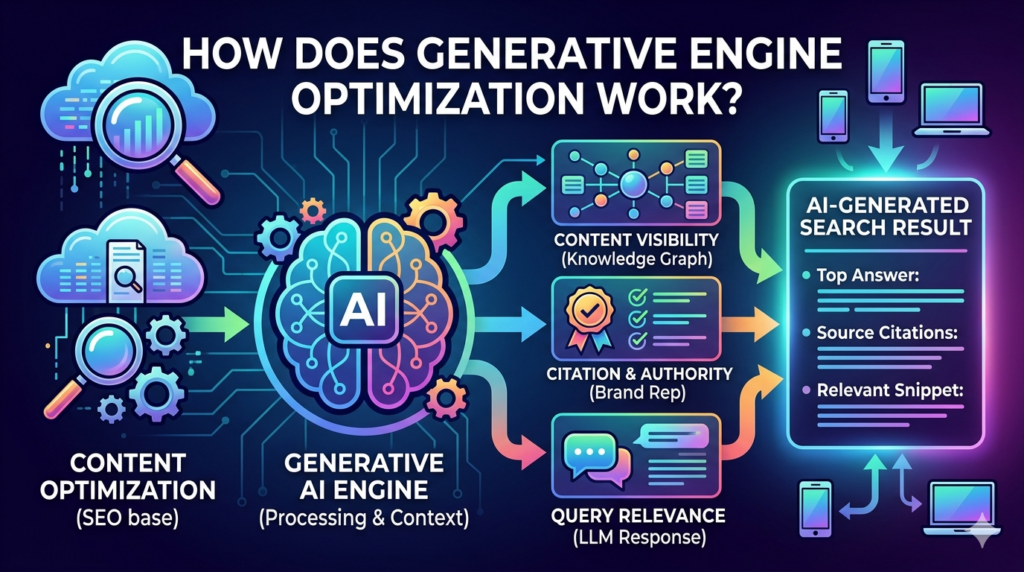
GEO works by aligning your content with the specific extraction and credibility signals that AI engines use to decide which sources to cite. AI engines using RAG (Retrieval-Augmented Generation) architectures — including ChatGPT Browse, Perplexity.ai, and Google’s Gemini — retrieve candidate documents from a web index and then select which passages to incorporate based on structural clarity, entity definition, inline evidence, and author authority.
According to Aggarwal et al. (Princeton NLP Group, 2024), structural optimization strategies — including answer-first paragraphs, inline source citations, and addition of authoritative statistics — improved AI engine citation rates by 30–40% in controlled testing across 10,000 queries. GEO is the practice of systematically applying these signals to your content.
The Mechanism: How AI Engines Process Web Content
AI engines follow a four-stage process — crawl, index, retrieve, generate — and GEO optimizes content for stages three and four, where citation decisions are made.
Stage 1 — Crawl
AI engine crawlers discover and fetch web pages from the public internet, similar to search engine bots.
- Bots follow links, read sitemaps, and fetch page HTML
- Content that is not crawlable (JavaScript-only rendering, noindex directives, login walls) is invisible to AI engines
- JSON-LD schema communicates metadata to the crawler before it reads the body text — it is read at this stage
Stage 2 — Index
Crawled content is processed into a retrieval index: pages are parsed into text chunks, entities are extracted, and the content is stored for retrieval.
- Pages are broken into passages of roughly 100–500 tokens
- Entity names, definitions, and relationships are extracted from the text
- Passages without clear entity anchors are harder to index accurately
- Content with undefined acronyms or inconsistent entity naming creates ambiguity in the index
Stage 3 — Retrieve
When a user submits a query, the AI engine searches the index for the most relevant candidate passages.
- The retrieval engine uses semantic similarity, not just keyword matching
- Passages are ranked by relevance to the specific query
- Multiple passages from multiple pages are retrieved as candidates
- Pages with strong topical authority — from content clusters covering the subject comprehensively — are retrieved more consistently, per HubSpot’s 2023 Content Marketing research on hub-and-spoke architecture
Stage 4 — Generate and Cite
The AI model synthesizes a response using retrieved passages and selects which sources to attribute.
- The model evaluates retrieved passages for: structural clarity (is the answer self-contained?), credibility (is the claim supported by evidence placed adjacent to it?), and author authority (is the source named and credentialed?)
- According to Lewis et al. (Meta AI Research, 2020) and confirmed by Aggarwal et al. (Princeton NLP Group, 2024), passages with inline citations are cited at significantly higher rates than equivalent unsourced passages
- Promotional language, unsupported superlatives, and vague entity references reduce citation confidence at this stage
The Six GEO Content Signals That Drive Citation
GEO works because each of the following content signals addresses a specific decision point in the AI engine’s generation stage.
| GEO Signal | What It Does for the AI Engine | Citation Impact |
| Answer-first structure | Provides a self-contained extractable response in the first 2 sentences | High — first-sentence answers are extracted 30–40% more frequently (Princeton NLP Group, 2024) |
| Entity definition and clarity | Anchors content to knowledge graph nodes AI engines recognize | High — undefined entities reduce indexing accuracy |
| Inline citations | Confirms the claim is sourced, placed adjacent so the model connects claim to support | High — top-performing GEO intervention per Princeton NLP Group, 2024 |
| Author credentialing | Establishes trust via E-E-A-T signals: named author + specific title + affiliation | Moderate-High — consistent with Google’s E-E-A-T framework (Search Quality Rater Guidelines, 2023) |
| JSON-LD schema | Communicates content type, author, topic, and entity relationships before body text is read | Moderate — reduces extraction ambiguity |
| Topical cluster architecture | Signals comprehensive subject-area coverage across multiple interlinked pages | High (long-term) — per HubSpot’s 2023 Content Marketing research on cluster vs. standalone page performance |
What Prevents GEO From Working
The most common reasons AI engines pass over content without citation are structural, not qualitative — the content may be accurate and well-written but fail on extractability.
- Buried answers — The direct answer to the section heading’s implied question appears in paragraph three or later; AI extraction skips it
- Undefined entities — Acronyms expanded nowhere, key terms used without definition; the AI cannot anchor the content to its knowledge graph
- Separated evidence — Source citations placed in a bibliography at the bottom rather than adjacent to the claims they support; the AI does not connect claim to evidence
- Anonymous authorship — No named author, no credentials; reduced E-E-A-T score lowers citation confidence even for accurate content
- No schema markup — Without JSON-LD, the AI crawler reads metadata less reliably and may misclassify the content type
- Thin topical coverage — A single page with no related cluster content; AI engines prefer sources that demonstrate comprehensive topic ownership
Frequently Asked Questions
Question: Does GEO work differently for ChatGPT vs. Perplexity? Answer: Both use RAG architectures that retrieve web content and synthesize responses, so the same content signals drive citations on both platforms. Perplexity cites every source explicitly with a URL, making citation tracking easier. ChatGPT Browse is more selective about which sources it links to. The underlying content quality and structure requirements are essentially identical — optimize for one and you optimize for both.
Question: Does having a high-domain-authority website automatically mean good GEO performance? Answer: Domain authority helps but does not guarantee GEO citations. Aggarwal et al. (Princeton NLP Group, 2024) found that structural content signals — answer-first placement, inline citations, entity clarity — were stronger predictors of citation frequency than assumed authority proxies. A well-structured page on a medium-authority domain can outperform a poorly structured page on a high-authority domain for AI citation.
Question: Can GEO work for video or audio content? Answer: AI engine text extraction primarily targets HTML text. Video and audio content is not directly extracted. However, transcript-based text pages derived from video or podcast content — formatted to GEO standards — are fully eligible for citation. The text layer is the citation target; the media format is not.
Question: Why does schema markup matter if AI engines can read the page text directly? Answer: Schema markup communicates metadata — content type, author, date modified, topic, entity relationships — before the AI crawler reads a single word of body text. It provides a structured, unambiguous signal layer that reduces misclassification and improves the accuracy of entity anchoring in the index. Pages with correctly implemented schema are consistently crawled and categorized more accurately than equivalent pages without it.
Author
ABC Editorial Team | GEO & AI Visibility Specialists | ABC (abcleadgen.com) ABC designs GEO content programs built on the technical understanding of how AI engines crawl, index, retrieve, and generate from web content. The team’s four-stage framework ensures every GEO optimization targets the precise stage where citation decisions are made. Last updated: June 2026 | Next review: Monthly
