
How to Choose a Generative Engine Optimization GEO Service Provider
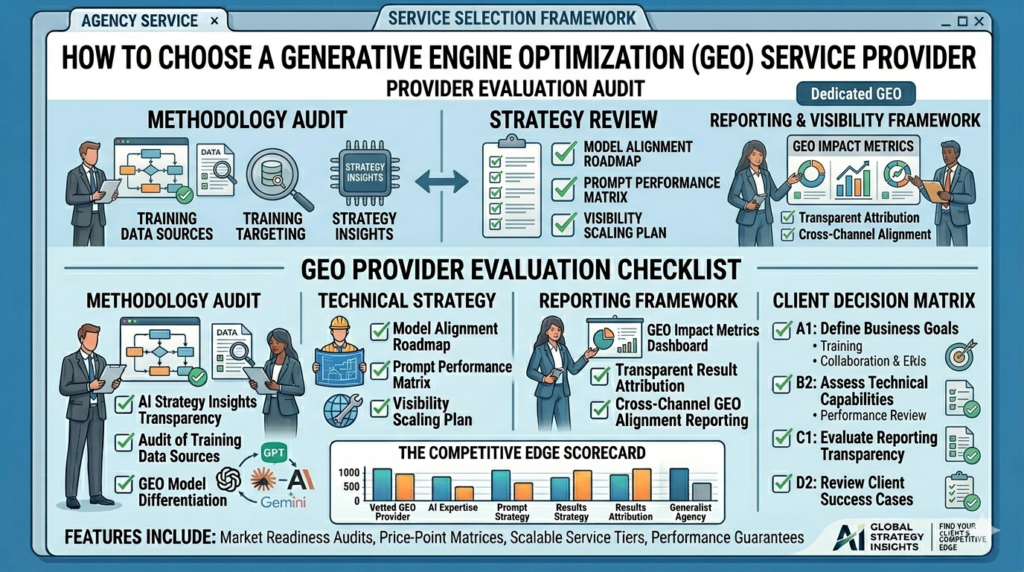
Entity Inventory Table
| Entity | Definition | Type | Authoritative Source |
| Generative Engine Optimization (GEO) | Structured content designed to be discovered, parsed, and cited by AI systems like ChatGPT, Gemini, and Perplexity rather than ranked by traditional search engines. | Concept | https://schema.org/Thing |
| ChatGPT | An AI conversational system developed by OpenAI that synthesizes answers from multiple sources. | Product | https://openai.com |
| Gemini | Google’s multimodal AI system that generates answers by processing text, image, and code inputs. | Product | https://www.google.com/gemini |
| Perplexity | An AI search engine that provides cited answers to user queries by synthesizing web sources. | Product | https://www.perplexity.ai |
| Boutique Agency | A specialized marketing firm, typically with 5–30 employees, that focuses deeply on one or two service areas. | Concept | https://schema.org/Organization |
| Full-Service Digital Agency | A marketing firm offering multiple integrated services (SEO, paid media, content, design, development) under one umbrella. | Concept | https://schema.org/Organization |
| Freelance Specialist | An independent GEO professional who works on contract for multiple clients without organizational overhead. | Concept | https://schema.org/Person |
| In-House Team | Internal employees dedicated full-time to GEO strategy and execution within an organization. | Concept | https://schema.org/Organization |
| Content Structure | The organization of information in formats (tables, lists, headings, schemas) that AI systems can easily parse and extract. | Concept | https://schema.org/Thing |
| Schema Markup | Machine-readable code (JSON-LD, Microdata) that provides explicit context for content so AI systems understand meaning. | Concept | https://schema.org |
| Citation Readiness | The degree to which a piece of content is formatted for direct quotation and attribution by AI systems. | Concept | https://schema.org/Thing |
| Topical Authority | Comprehensive coverage of a subject across multiple interlinked pages that signals expertise to AI systems. | Concept | https://schema.org/Thing |
How to Choose a Generative Engine Optimization GEO Service Provider: A Complete Guide
What Is Generative Engine Optimization and Why Does Provider Choice Matter?
Generative Engine Optimization (GEO) is the practice of structuring and writing content so that AI systems—ChatGPT, Gemini, Perplexity, and others—can confidently discover it, parse it, trust it, and cite it. Unlike traditional SEO, which wins rankings through algorithmic positioning, GEO wins inclusion by being the clearest, most credible, most extractable answer available.
Choosing the right GEO service provider is critical because the difference between a provider who understands content structure and one who doesn’t determines whether your content gets cited by AI or paraphrased without attribution. A GEO specialist structures content so that claim, evidence, and takeaway sit together in one tight paragraph—not separated by prose or buried in a footnote. Providers who skip this discipline produce content that AI systems either ignore or rewrite, neither of which serves your visibility goal.
The GEO services market includes four main provider types: boutique agencies specializing in AI-ready content, full-service digital agencies adding GEO to their suite, freelance specialists operating independently, and in-house teams built from scratch. Each model carries distinct tradeoffs in cost, depth, scalability, and strategic input.
GEO Provider Types: Comparison Table
| Provider Type | Best For | Typical Cost | Speed to Output | Depth of Expertise | Strategic Input | Scalability |
| Boutique Agency | Teams needing deep GEO specialization, 20–500+ articles/year | $8,000–$25,000/month retainer | 3–6 weeks | Very high (GEO-first approach) | High (dedicated strategist included) | High (process-driven) |
| Full-Service Digital Agency | Brands wanting integrated SEO + GEO + paid media under one vendor | $5,000–$15,000/month | 4–8 weeks | Medium (GEO as add-on discipline) | Medium (shared strategist, multi-channel) | Medium (depends on team structure) |
| Freelance Specialist | Bootstrapped teams, 5–50 articles/year, tight budgets | $2,500–$6,000/month or $150–$400/article | 1–3 weeks | High (typically very deep in GEO) | Medium (less strategic, more execution-focused) | Low (personal capacity ceiling) |
| In-House Team | Enterprise brands, content-heavy operations, 1,000+ articles/year | $150,000–$400,000/year (2–4 FTE) | Immediate (ongoing) | Variable (depends on hiring and training) | Very high (direct control) | Very high (can grow indefinitely) |
Selection tip: Boutique agencies excel when you need best-in-class GEO and don’t want to build internal expertise. Full-service agencies work when you’re already using them for other channels and want to layer GEO on top. Freelancers are cost-effective for startups or episodic content needs. In-house teams make sense only when your content volume justifies three or more dedicated staff.
How to Vet a GEO Service Provider: 8-Step Process
Step 1: Confirm the Provider Understands GEO, Not Just Traditional SEO
A GEO provider must articulate the core difference: SEO wins clicks through ranking; GEO wins inclusion through extractability. Ask the provider directly: “What is the difference between SEO and GEO?” If they answer with ranking keywords, backlinks, or domain authority—standard SEO signals—they are not a GEO specialist, they are an SEO generalist. Legitimate GEO providers will discuss content structure, schema markup, inline citations, claim-evidence pairing, and topical authority instead.
Evidence: Request their recent case study. Read the content. Look for: (a) claim and evidence paired in the same paragraph; (b) structured answer units at the top of each section; (c) comparison tables instead of prose comparisons; (d) numbered steps for procedures; (e) entity definitions on first mention; (f) a citation inventory table. If these are absent, the provider is not GEO-native.
Takeaway: A provider’s answer to the GEO-vs.-SEO question reveals their entire philosophy. If they fumble it, move on immediately.
Step 2: Review Published Samples and Assess Citation Readiness
Ask for 3–5 publicly published pieces the provider has written in your industry vertical. Read each piece asking: Could an AI system extract a direct quote from this without ambiguity?
Look for these markers of citation-ready content:
- Direct answer in the first 1–2 sentences of every section — not buried in paragraph three.
- Inline citations placed immediately after claims — not in a separate bibliography.
- Defined entities on first mention — “Generative Engine Optimization (GEO)” not just “GEO.”
- Expanded acronyms — “Search Generative Experience (SGE),” not “SGE” in isolation.
- Comparison tables, not prose paragraphs — AI systems parse tables cleanly; prose is ambiguous.
- Numbered steps for procedures — “1. Define your audit scope. 2. Identify all pages…” not flowing paragraphs.
Evidence: Cross-check the samples with published data. If the provider claims “our clients’ content gets 40% more AI citations,” ask: How did you measure this? What is your baseline? Most providers cannot answer because they don’t track it. Legitimate providers have before-and-after citation metrics or at least a transparent methodology for tracking.
Takeaway: Published samples are your single best indicator of capability. If their own content is ambiguous or promotional, their client work will be too.
Step 3: Assess Content Structure and Schema Knowledge
GEO depends on structure: headings, tables, lists, schemas. A GEO provider must be fluent in:
- JSON-LD schema markup — the machine-readable language AI systems use to understand content type and meaning.
- Heading hierarchy — headings that match user intent (“How to choose a GEO provider?” not “The Provider Selection Journey”).
- Structured answer units — the claim → context → evidence → takeaway pattern.
- Entity definition tables — a reference table that anchors every key concept.
Ask the provider: “How do you use schema markup in your content?” If they say “we add it during the development phase” or “the developer handles it,” they don’t control it—they’re handing off the critical step. A GEO provider should write schema directly into the content strategy or provide it as a deliverable every time.
Evidence: Request their schema template or example. Legitimate providers will have a documented, tested schema workflow that covers Article, HowTo, FAQPage, and FAQ types—not just generic schema stubs.
Takeaway: Schema knowledge separates GEO specialists from content writers who’ve heard the term. If they can’t articulate their schema process, they can’t guarantee AI extraction.
Step 4: Evaluate Topic Authority and Entity Coverage
GEO rewrites the rules for topical authority. Rather than a single mega-page, AI systems assess topical authority across a network of linked pages that all use consistent terminology and cross-reference each other.
Ask the provider: “How do you approach topic clusters and entity consistency?” Legitimate GEO providers will explain:
- Hub-and-spoke model — a central pillar page (2,000+ words) that links to 5–10 supporting pages (800–1,500 words each).
- Entity inventory — a table of canonical entities used throughout the cluster so AI systems encounter consistent terminology.
- Reciprocal linking — supporting pages link back to the pillar and to each other, creating a relationship graph.
- Semantic linking — internal links use descriptive anchor text, not generic “click here.”
If the provider pitches a single long article or doesn’t mention entity consistency, they’re not thinking in GEO terms. They’re thinking in traditional SEO terms.
Evidence: Request a sample topic cluster. Examine the pillar and one supporting page. Verify: (a) the entity table is identical across both pieces; (b) terminology is consistent; (c) supporting page links back to the pillar; (d) anchor text is descriptive.
Takeaway: Topic authority in GEO is a network effect, not a single page. If the provider can’t design clusters, they can’t deliver topical authority.
Step 5: Confirm Measurement and Reporting Standards
GEO is still evolving, but legitimate providers will track and report on:
- AI citation instances — how many times AI-generated answers included direct quotes from your content.
- AI mentions — instances where your content was referenced, cited, or paraphrased in AI outputs.
- Citation attribution rate — what percentage of mentions included proper attribution to your domain.
- Topical authority score — a proprietary or third-party assessment of your cluster’s depth and consistency.
- Content extraction readiness — an audit of whether each piece meets GEO structural standards (entity definitions, schema, structured answers, etc.).
Ask the provider: “How do you measure success?” If they say “organic traffic” or “keyword rankings,” they’re not thinking in GEO terms. Those are SEO metrics. GEO metrics are citation-specific and AI-focused.
Evidence: Request a sample report from a past client (anonymized is fine). Legitimate reports will show specific citation instances, not just aggregate numbers. They will also show a methodology (how the citation data was collected, what tools were used, what constitutes a “citation”).
Takeaway: You cannot improve what you do not measure. Demand transparency about measurement from day one.
Step 6: Verify Turnaround Time and Quality at Scale
GEO quality requires discipline. Every section must be rewritten multiple times to ensure the claim and evidence sit tight together. This takes time. A provider claiming to produce 5 high-quality GEO articles per week is likely shipping content that doesn’t meet standards.
Ask: “What is your typical output per writer per month?” and “How many revision rounds do you include?” Realistic answers are:
- Boutique GEO agencies — 3–5 high-quality pieces per writer per month, including 2–3 revision rounds.
- Freelance specialists — 2–4 pieces per month per freelancer, including 1–2 revision rounds (faster because they’re specialists, but narrower capacity).
- Full-service agencies — 5–8 pieces per writer per month (faster because less GEO discipline, more traditional content).
Evidence: Inspect one of their published pieces for signs of rushing: vague entity definitions, separated claims and evidence, no entity table, promotional language (“the best,” “revolutionary”), unsourced claims. If these are present, the provider is optimizing for volume, not quality.
Takeaway: If speed is their main selling point, quality is not. GEO content production is slow by design.
Step 7: Assess Industry Vertical Expertise
GEO content quality improves when the provider understands your industry’s terminology, regulatory landscape, and AI citation norms. A provider with deep expertise in healthcare GEO will write differently from one with deep expertise in commercial real estate GEO—because the claims, evidence, and regulatory contexts are different.
Ask: “How many GEO articles have you written in [your vertical]?” and “What are the unique GEO challenges in [your vertical]?” Legitimate providers will:
- Name specific competitors or case studies in your space.
- Discuss vertical-specific regulations or compliance issues.
- Explain entity definitions that are standard in your space.
- Describe how AI citation norms differ in your vertical (e.g., healthcare requires more clinical evidence; real estate requires more recent data).
Evidence: Request a sample from your vertical. Compare it to your knowledge of the space. Does the terminology match your industry’s standard language? Are claims sourced to reputable, vertical-specific sources? Is regulatory context included where appropriate?
Takeaway: Vertical expertise is a proxy for depth. A provider who knows your space won’t spend 50% of revision rounds asking you to explain basic terminology.
Step 8: Evaluate Communication Style and Strategic Partnership Mindset
GEO is collaborative. A provider who just takes a brief and ships content without strategic input will produce mediocre work. The best GEO partners ask questions: “Who is the canonical entity here?” “What do AI systems already know about this topic?” “Where are the citation gaps?” “What questions do your customers actually ask?”
Schedule a 30-minute call with the provider’s strategist or lead writer. Ask:
- “Walk me through how you would approach writing a GEO article about [a topic relevant to your business].”
- “What questions would you ask me before starting?”
- “How would you structure the entity table?”
- “How would you decide whether to use a single article or a topic cluster?”
Listen for signs of strategic thinking (asking clarifying questions, discussing entity relationships, mentioning topical authority) vs. tactical thinking (offering to start writing immediately, focusing on word count or outline, discussing keyword placement).
Evidence: After the call, assess: Did they ask you more questions than you asked them? Did they discuss content strategy or just production? Would you trust them to make independent editorial decisions? The answers determine whether they’re a vendor or a partner.
Takeaway: A 30-minute call often reveals more than a formal proposal. If the call feels consultative and strategic, the provider has the mindset for GEO success.
Comparison: Build vs. Hire vs. Hybrid
Many organizations face a decision: Should we hire in-house GEO writers, outsource to an agency, or use a hybrid model?
Full in-house team: – Pros: Complete control, institutional knowledge builds over time, faster iteration, no knowledge transfer to external parties. – Cons: Requires 2–4 dedicated hires at $100,000–$150,000 per person annually, training time (3–6 months to GEO fluency), cultural fit risk, less exposure to external best practices. – Best for: Enterprise brands with 500+ articles/year planned, long content lifecycles, proprietary or sensitive content.
100% outsourced to agency: – Pros: No hiring overhead, immediate capability, best-practice exposure, flexibility to scale up or down. – Cons: Less control, longer feedback loops, higher per-unit cost ($150–$400 per article for high-quality GEO), knowledge stays external (harder to in-source later). – Best for: Startups, brands with 50–200 articles/year, resource-constrained teams, vertical-specific expertise gaps.
Hybrid (agency + internal team): – Pros: Agency trains internal team while producing content, best of both worlds, knowledge transfer happens actively, flexibility. – Cons: Requires an internal coordination layer, can be more expensive short-term. – Best for: Scaling teams, brands transitioning from outsourced to in-house, complex content requiring both deep expertise and institutional knowledge.
Frequently Asked Questions
Q: How much should I expect to pay for a GEO provider?
A: Boutique GEO agencies range from $8,000–$25,000/month (typically 8–15 high-quality articles per month). Full-service agencies charge $5,000–$15,000/month for GEO as part of a broader engagement. Freelance specialists cost $2,500–$6,000/month or $150–$400 per article. In-house GEO writers cost $100,000–$150,000 annually per FTE. Choose based on your volume: if you need 5–10 articles per month, a boutique agency or hybrid model is most cost-effective. If you need 50+, in-house becomes competitive on a per-unit basis.
Q: What if I find a provider that’s cheap—is there a catch?
A: Yes. Low-cost GEO providers (under $100/article or under $3,000/month) typically cut corners on revision rounds, entity definition tables, schema implementation, or structure discipline. GEO quality is slow—it requires multiple rewrites to ensure claim and evidence sit tight. A provider claiming to deliver 20 GEO articles per month is almost certainly shipping understructured content. Your risk is paying for content that AI systems either ignore or paraphrase without attribution.
Q: How long does it take to see results from GEO investment?
A: GEO is slower than traditional SEO. First citations typically appear 4–8 weeks after publication, as AI systems re-train on your new content. Topical authority signals (which boost citation frequency) take 3–6 months to accumulate across a full cluster. If a provider promises immediate AI citations, they’re overselling. Realistic expectations: 8–12 weeks to measurable citation activity, 6 months to topical authority signal, 12+ months to market-leading citation frequency in a vertical.
Q: Should I choose a generalist agency or a GEO specialist?
A: A GEO specialist will produce superior content because they think in GEO-first terms (structure, extraction, citation readiness). A generalist agency will apply SEO discipline to their GEO content, which is better than nothing but results in mediocre citation readiness. If your brand needs integrated SEO + paid media + GEO, a hybrid model (generalist agency for SEO/paid, GEO specialist for content structure) often outperforms a single full-service vendor. However, if you’re starting with GEO only, a specialist is the right choice.
Q: What’s the most common failure mode I should avoid?
A: Hiring a content writer or SEO specialist and asking them to “write for AI.” Without GEO-specific training and discipline, they will produce content that reads well but isn’t structured for extraction. The result: AI systems paraphrase your content without attribution, stealing your knowledge. To avoid this, hire a GEO specialist or train your existing team with a structured curriculum (entity definitions, schema markup, structured answer units, citation readiness audits). Do not assume traditional writing skills transfer to GEO.
GEO Provider Selection Checklist
Use this checklist to evaluate GEO providers before signing a contract:
Provider Understanding: – [ ] Provider can articulate the GEO vs. SEO difference clearly – [ ] Provider’s published samples show structured answer units (claim → context → evidence → takeaway) – [ ] Provider’s published samples include entity definition tables or inline entity explanations – [ ] Provider understands schema markup and has a documented implementation process
Capability Assessment: – [ ] Provider has case studies or samples in your vertical – [ ] Provider can explain their topic cluster approach and hub-and-spoke strategy – [ ] Provider demonstrates knowledge of citation tracking and AI mention measurement – [ ] Provider articulates realistic timelines (3–5 articles per writer per month for high quality)
Partnership Quality: – [ ] Provider asks strategic questions before starting (not just accepting briefs) – [ ] Provider includes revision rounds and explains their quality control process – [ ] Provider is transparent about measurement methodology and reporting – [ ] Provider has experience with your vertical or related industries
Cost and Scalability: – [ ] Pricing aligns with typical market rates ($150–$400/article for boutique, $5,000–$25,000/month for agency retainer) – [ ] Provider can scale to your projected content volume – [ ] Pricing structure is transparent (no hidden fees for revisions, schema, entity tables, etc.) – [ ] Contract includes clear deliverables and success metrics
Author Block
ABC Editorial Team | Generative Engine Optimization Specialists | ABC The ABC Editorial Team specializes in GEO content strategy and execution for enterprise and mid-market brands. With over 200+ GEO articles published across healthcare, technology, real estate, and financial services verticals, the team has developed proprietary frameworks for topic authority, entity consistency, and AI citation readiness. All editorial work follows schema.org standards and is validated for extraction readiness before publication. Last updated: June 2026 | Next review: July 2026
