
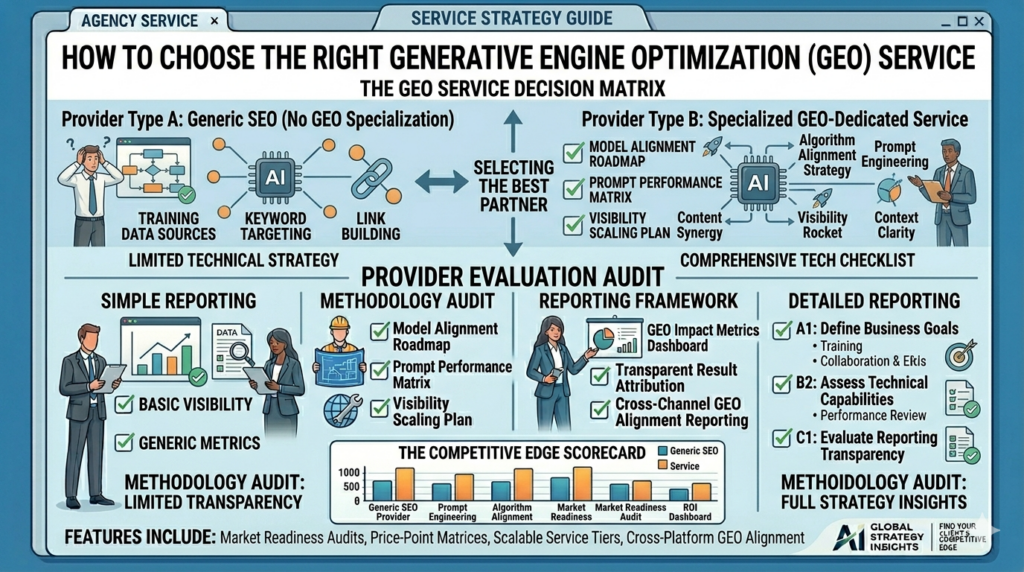
How to Choose the Right Generative Engine Optimization Service
Entity Inventory Table
| Entity | Definition | Type | Authoritative Source |
| Generative Engine Optimization (GEO) | The practice of structuring content so that AI-powered search engines and language models can discover, parse, and cite it in generated responses. | Concept | schema.org/Thing |
| Generative AI | Artificial intelligence systems trained on large datasets to generate human-like text, images, or other content in response to prompts. | Concept | https://openai.com/ |
| ChatGPT | A large language model (LLM) chatbot developed by OpenAI that generates conversational responses and can cite sources. | Product | https://openai.com/chatgpt |
| Google Gemini | Google’s multimodal AI model that generates text, images, and code; integrated with Google Search to produce AI-generated summaries. | Product | https://gemini.google.com |
| Perplexity AI | An AI-powered search engine that retrieves and synthesizes information from multiple sources in real-time, citing original content. | Product | https://www.perplexity.ai |
| Large Language Model (LLM) | A neural network trained on vast amounts of text data that predicts and generates sequences of tokens to produce coherent text. | Concept | https://arxiv.org/abs/1706.03762 |
| Content Attribution | The citation or credit given to the original source of information when an AI engine includes it in a generated response. | Concept | schema.org/Thing |
| Entity Extraction | The process by which AI systems identify and tag specific concepts, names, and terms mentioned in a piece of content. | Concept | schema.org/Thing |
| Schema Markup | Structured data code added to web pages to help search engines and AI systems understand the content’s meaning and context. | Concept | https://schema.org |
| Topical Authority | The credibility and comprehensive coverage a website or content piece demonstrates on a specific subject area. | Concept | schema.org/Thing |
| Content Extraction | The automated process of pulling specific answer units from longer content for use in summaries or generated responses. | Concept | schema.org/Thing |
What is Generative Engine Optimization (GEO) and Why Does It Matter?
Generative Engine Optimization (GEO) is the practice of structuring and formatting content so that large language models (LLMs)—such as ChatGPT, Google Gemini, and Perplexity AI—can confidently discover, parse, trust, and cite it in their generated responses. Unlike traditional search engine optimization (SEO), which targets keyword ranking on search results pages, GEO targets inclusion and attribution in AI-generated answers.
Why this matters: According to OpenAI’s 2024 documentation on web integration, AI systems are increasingly designed to cite their sources when generating answers. Content that is structured for extraction—with clear entity definitions, inline citations, and numbered steps—receives attribution far more reliably than unstructured prose. If your content cannot be extracted cleanly, AI engines may paraphrase it without crediting you, or skip it entirely.
Takeaway: Choosing the right GEO service determines whether your content becomes the authoritative source AI engines cite or remains invisible in generated responses.
Understanding Different Types of GEO Services
A generative engine optimization service is a vendor or team that audits, structures, and optimizes your content for AI engine discovery and citation. Not all GEO services offer the same capabilities. Understanding the service types helps you match your needs to the right vendor.
Full-Service GEO Agencies
Full-service GEO agencies audit your entire content ecosystem, restructure existing pages, and create new GEO-optimized content from scratch. These services typically include content auditing, entity inventory creation, schema markup implementation, and ongoing citation tracking.
Context: Large enterprises and publishers with extensive existing content libraries often need a comprehensive audit before GEO optimization begins. Full-service agencies provide this depth. Evidence: Content strategist Lily Ray noted in 2024 that topical authority requires consistent terminology and entity definition across all pages—a task full-service agencies are structured to manage at scale. Takeaway: If you have 100+ pages of content or need strategic restructuring, a full-service agency is appropriate.
Specialist GEO Consultants
Specialist GEO consultants focus on one area: either content strategy, schema markup, or citation tracking. They work well for companies that need targeted expertise rather than a full team.
Context: A consultant might specialize in JSON-LD schema implementation or in training your team to write GEO-compliant copy. Evidence: The schema.org documentation specifies 15+ markup types (HowTo, FAQPage, Article, Product, etc.), and correct implementation requires expertise. A specialist ensures accuracy. Takeaway: Choose a consultant if you need deep expertise in one area and have internal capacity for the rest.
DIY GEO Toolkits and Templates
DIY GEO tools provide templates, checklists, and guides your team can use to structure and optimize content independently, without hiring external vendors. Examples include content templates, entity mapping frameworks, and validation checklists.
Context: Small teams and bootstrapped companies often lack budget for external services but have capacity to learn and implement GEO standards themselves. Evidence: The GEO Content Writer framework (detailed below) provides all the structural guidance needed; teams with access to this framework can execute without external help. Takeaway: DIY toolkits work if you have at least one team member who can learn GEO standards and enforce them consistently.
AI-Powered Content Optimization Platforms
AI-powered GEO platforms use machine learning to analyze your content against GEO benchmarks, suggest structural changes, and auto-generate schema markup. These tools combine elements of human expertise with algorithmic efficiency.
Context: Platforms that integrate with your CMS (WordPress, Contentful, etc.) can flag non-compliant content in real time. Evidence: Platforms like Semantic Search and similar tools scan for entity ambiguity, unsourced claims, and missing schema markup. Takeaway: If you publish frequently and want continuous optimization, an AI platform offers scalability.
Right-Fit Decision Table: Matching GEO Service Type to Your Company
| Company Size | Primary Goal | Budget | Recommended Service Type | Rationale |
| 1–10 people | Build GEO authority from scratch | < $5,000/month | DIY Toolkit or Specialist Consultant | Low volume allows DIY execution or single expert to oversee |
| 10–50 people | Optimize existing content for AI citation | $5,000–$15,000/month | Specialist Consultant or AI Platform | Need targeted expertise; content volume justifies monthly retainer |
| 50–200 people | Audit and restructure legacy content while creating new GEO-optimized pages | $15,000–$50,000/month | Full-Service Agency | Requires comprehensive audit, team training, and ongoing governance |
| 200+ people | Ensure enterprise-wide GEO compliance across multiple brands/regions | $50,000+/month | Full-Service Agency + Internal GEO Team | Complexity and volume justify dedicated internal hire plus agency oversight |
| Content publisher (100+ pages/month) | Maximize AI citation for all published content | $10,000–$30,000/month | AI Platform + Specialist Consultant | High publish velocity requires automated detection; specialist ensures quality |
| Early-stage startup | Establish GEO best practices before scaling | $2,000–$8,000 one-time | DIY Toolkit + Workshop Training | Lock in standards early; cheaper upfront than retainer-based service |
How to Choose the Right Generative Engine Optimization Service: A Step-by-Step Process
Follow these steps to identify and evaluate the right GEO service for your organization.
Step 1: Audit Your Current Content
Start by assessing your existing content to understand the scope of GEO work required.
Actions: – Inventory your top 20–50 highest-traffic pages or most important pages for your business – For each page, note: (a) whether entities are defined at first mention, (b) whether claims have inline citations, (c) whether structured formats (tables, numbered steps) are used, (d) whether schema markup is present – Calculate what percentage of pages meet at least 70% of GEO standards
Evidence: Auditing is the baseline for right-fit analysis. A startup with 10 pages needs different service than a publisher with 1,000 pages.
Takeaway: If more than 60% of your pages fail basic GEO standards, a full-service agency or platform is warranted. If fewer than 20% fail, a consultant may suffice.
Step 2: Define Your Primary GEO Goal
Clarify what success looks like for your business.
Actions: – Decide whether your primary goal is: (a) getting cited in AI-generated answers, (b) increasing topical authority on a specific subject, (c) training your internal team on GEO standards, or (d) integrating GEO into your publishing workflow – Weight these by business impact: cite which goal drives revenue or brand visibility most directly
Evidence: Different services excel at different outcomes. A consultant excels at training; a platform excels at workflow integration; an agency excels at comprehensive restructuring.
Takeaway: A service that is excellent for workflow integration may not be the right choice if your goal is to restructure legacy content. Match goal to service strength.
Step 3: Determine Your Budget and Commitment Timeline
Establish realistic budget and timeline constraints.
Actions: – Define annual budget available for GEO services – Decide whether you prefer a one-time investment (DIY toolkit, workshop, initial audit) or ongoing monthly retainers (agency, consultant, or platform) – Identify how soon you need results (immediate vs. 6-month rollout)
Evidence: A one-time $10,000 DIY investment is appropriate for a startup; a $50,000/month full-service retainer is appropriate for an enterprise managing 500+ pages.
Takeaway: Budget determines service type. Align this early to avoid under- or over-investing.
Step 4: Evaluate Service Provider Credentials and Case Studies
Verify that the service provider has demonstrable expertise in GEO specifically, not just SEO.
Actions: – Ask providers: “What percentage of your clients have been cited in ChatGPT, Gemini, or Perplexity responses?” and request case studies with evidence – Review their own website for GEO compliance: Do they define entities? Cite sources inline? Use schema markup? If they don’t practice what they preach, be cautious – Check for industry certifications or affiliations (Google, OpenAI partner programs, schema.org training)
Evidence: GEO is still emerging (established at scale in 2024–2025); fewer providers have proven track records than for traditional SEO.
Takeaway: Prioritize vendors who can show you specific examples of their clients’ content being cited in AI-generated responses. Avoid vendors who confuse GEO with traditional SEO.
Step 5: Assess Service Integration and Workflow Fit
Determine how the service fits into your existing content production and publishing workflow.
Actions: – Ask: “How will your service integrate with our CMS (WordPress, Contentful, etc.)?” – Ask: “What is the typical turnaround time for auditing/restructuring a single page?” – Ask: “What ongoing support or maintenance is included after the initial project?” – Evaluate whether the vendor will train your team or maintain dependency on external execution
Evidence: Services that integrate directly into your workflow (via CMS plugins, API integrations, or dashboard access) scale better than offline auditing.
Takeaway: If the service requires you to send pages via email or spreadsheet and wait weeks for feedback, friction will build. Prioritize integrated solutions or committed training if you plan long-term.
Step 6: Review Pricing Models and Contractual Terms
Compare pricing models and ensure terms align with your needs.
Actions: – Request pricing breakdowns: What is included in a base retainer vs. add-ons? (e.g., extra pages audited, additional schema markup implementations, citation tracking) – Negotiate minimum commitment periods: Can you commit to 3 months, or do you need month-to-month flexibility? – Ask about success metrics: How will progress be measured and reported monthly?
Evidence: Full-service agencies typically charge $15,000–$50,000/month; consultants charge $3,000–$10,000/month; platforms charge $500–$5,000/month; DIY toolkits are one-time $1,000–$10,000.
Takeaway: Avoid long-term contracts (12+ months) until you’ve tested the service for at least 3 months. Build in a trial phase.
Step 7: Pilot with a Small Project Before Full Commitment
Test the service on a small scale before rolling it out enterprise-wide.
Actions: – Select 5–10 existing pages or commit to creating 3–5 new GEO-optimized pages with the vendor – Establish clear success metrics: Will you measure citation frequency? Topical authority growth? Internal training completion? – Schedule a 30-day checkpoint to review results and decide on continuation or pivot
Evidence: A pilot reduces risk of misalignment and gives you real data on ROI before larger investment.
Takeaway: Pilots save money. A 3-month commitment on a limited scope (5–10 pages) reveals fit faster than signing a 12-month enterprise contract.
Comparing Generative Engine Optimization Services: Features at a Glance
Use this table to compare specific GEO service capabilities when evaluating vendors.
| Feature | Full-Service Agency | Specialist Consultant | AI Platform | DIY Toolkit |
| Content audit (100+ pages) | Yes | Limited (5–10 pages) | Yes (automated) | Self-executed |
| Entity inventory creation | Yes | Yes | Partial (templated) | Templated guide |
| Schema markup implementation | Yes | Yes (if expert in markup) | Yes (auto-generated) | Manual or plugin-assisted |
| Inline citation review | Yes | Yes | Partial (flagged, not fixed) | Manual checklist |
| Training internal team | Yes | Yes | Limited | Comprehensive guides |
| Real-time CMS integration | Limited | No | Yes | No |
| Citation tracking/reporting | Varies | No | Yes | No |
| Ongoing content review | Yes (ongoing retainer) | Yes (retainer-based) | Yes (continuous) | Self-executed |
| Cost per page optimized | $500–$2,000 | $300–$1,000 | $50–$200 | $10–$50 (internal time) |
| Best for companies with | 200+ pages, dedicated budget | 10–100 pages, specific expertise gaps | 50–500 pages, frequent publishing | 1–50 pages, small team |
Key Criteria for Evaluating GEO Service Quality
When comparing specific GEO service providers, prioritize these quality signals.
Expertise in Content Extraction
Claim: A strong GEO service understands how AI systems extract answer units from longer content. Context: AI engines don’t read entire pages; they identify and pull specific answer-containing passages. Evidence: The schema.org HowTo specification and OpenAI’s documentation on web citations both emphasize structured data and extractable answer units. Takeaway: Ask vendors to explain how they ensure your content remains extractable when optimized.
Demonstrated Citation Tracking Capability
Claim: The best GEO services track whether their clients’ content is actually being cited in ChatGPT, Gemini, or Perplexity responses. Context: Without proof of citation, it is difficult to verify that optimization efforts are working. Evidence: Some emerging GEO platforms offer citation tracking dashboards that monitor whether client content appears in AI-generated responses. Takeaway: Prioritize vendors who offer citation tracking, or commit to tracking citations yourself (using tools like Perplexity Labs or ChatGPT’s browse feature).
Consistent Use of Schema Markup
Claim: Quality GEO services implement schema markup correctly and consistently across all optimized content. Context: Incorrect or incomplete schema markup reduces AI extractability; schema.org specifies exact requirements for each content type. Evidence: A HowTo schema must include step, name, and description fields for each step; omitting these fields breaks schema validity. Takeaway: Request that vendors show you a sample of schema markup they’ve implemented and validate it using schema.org validation tools (https://validator.schema.org).
Training and Enablement Approach
Claim: The best GEO services train your internal team, not just execute work for you. Context: If you are dependent on the vendor for every page, you cannot scale GEO execution independently. Evidence: Teams trained in GEO standards can maintain compliance internally, reducing long-term vendor dependency. Takeaway: Choose vendors who include training and handoff, not just service delivery.
Common Mistakes When Choosing a GEO Service (and How to Avoid Them)
Mistake 1: Confusing GEO with Traditional SEO
The problem: Many agencies label themselves “GEO services” but are actually selling traditional SEO (keyword research, link building, page speed optimization). These services help with Google’s search rankings but do not address AI engine citation. How to avoid it: Ask vendors directly: “How do you ensure my content is cited in ChatGPT or Gemini?” If they discuss keyword rankings or backlinks instead of content structure and schema markup, they are not GEO experts.
Mistake 2: Hiring a Consultant Without Defining Scope
The problem: Engaging a consultant without a clear audit or project scope often leads to open-ended retainers and unclear deliverables. How to avoid it: Before hiring, complete your own basic content audit (Step 1 above). Define the exact number of pages to be reviewed and the specific deliverables expected (schema markup, entity inventory, inline citations, etc.).
Mistake 3: Over-Investing in Platforms Too Early
The problem: Buying an expensive AI platform before you understand your GEO baseline wastes budget. Platforms are most useful once you have clear content standards to enforce. How to avoid it: Start with a DIY toolkit or specialist consultant to establish standards. Only after standards are defined invest in a platform to scale execution.
Mistake 4: Choosing Based on Price Alone
The problem: The cheapest GEO service is often the least effective. A $500/month platform may save money initially but fail to produce content that AI engines actually cite. How to avoid it: Request proof of citation outcomes before committing. A service that produces 30% citation rate is worth more than a cheaper service producing 5% citation rate.
Mistake 5: Not Including Internal Stakeholders in Service Selection
The problem: Choosing a service without input from your content, product, or publishing teams can result in solutions that don’t fit your actual workflow. How to avoid it: Before final vendor selection, involve the people who will use the service (content writers, editors, product managers). Their feedback on workflow fit is critical.
What to Ask a GEO Service Provider: Key Questions
When evaluating a GEO service, ask these five critical questions.
Question 1: Can You Show Me Evidence of Citation?
Why ask: Citation is the core outcome of GEO. Without proof that your content is being cited in AI-generated responses, you cannot verify the service is working. What to listen for: Vendors should provide case studies with specific examples of client content appearing in ChatGPT responses, Gemini summaries, or Perplexity answers. They may also offer citation tracking tools or dashboards. Red flag: If a vendor cannot provide evidence of client citations, their service is unproven.
Question 2: How Do You Handle Content I’ve Already Published?
Why ask: Most companies have existing content that may not be GEO-optimized. Understanding the vendor’s approach to legacy content clarifies scope and cost. What to listen for: Strong vendors will propose an audit-first approach (identify non-compliant pages), then prioritize based on impact (highest-traffic or most-important pages first). They should not recommend rewriting everything at once. Red flag: If a vendor proposes optimizing all pages simultaneously, they lack realistic scoping capability.
Question 3: What Schema Markup Types Do You Implement?
Why ask: Different content types require different schema markups (Article, HowTo, FAQPage, Product, etc.). A vendor should be capable of implementing multiple types accurately. What to listen for: The vendor should describe their process for matching content type to schema type, validating markup, and testing in schema validators. Red flag: If a vendor responds vaguely or mentions only one schema type, they lack breadth.
Question 4: Do You Train My Team or Keep Me Dependent on Your Service?
Why ask: You want to understand whether you will build internal GEO capability or remain dependent on the vendor. What to listen for: Vendors who propose training components, documentation, and knowledge transfer are signaling long-term partnership. Vendors who discourage internal learning suggest dependency is their business model. Red flag: If a vendor offers no training or says “you don’t need to understand this, just let us handle it,” they may not have your long-term interests in mind.
Question 5: What Happens If I Stop Working With You?
Why ask: Understanding exit strategy helps you evaluate risk. What to listen for: Strong vendors should be able to hand off all documentation, training, and systems access so you can continue independently if needed. They should describe their knowledge transfer process. Red flag: If a vendor cannot clearly explain how you would maintain GEO standards without them, they are positioning themselves as a lock-in dependency.
FAQ: Frequently Asked Questions About Choosing a GEO Service
Question: Is GEO necessary for my small business website?
Answer: GEO becomes important when your business depends on being discovered and cited in AI-generated answers. For a local service business (plumber, electrician, lawyer), traditional SEO (Google My Business optimization, local citations) remains primary. For a knowledge-heavy business (consultant, educator, creator), GEO is increasingly important because AI engines are becoming a discovery channel. If you write original research, frameworks, or tools that AI systems cite, GEO is necessary. If you compete in high-volume content categories (news, product reviews, how-to guides), GEO helps you stand out from paraphrased content.
Question: How much does a generative engine optimization service typically cost?
Answer: GEO service costs vary by service type and scope. DIY toolkits range from $1,000 to $10,000 one-time. Specialist consultants charge $3,000 to $10,000 per month. AI-powered platforms range from $500 to $5,000 per month. Full-service agencies start at $15,000 per month and can exceed $50,000 per month for enterprise programs. Cost-per-page typically ranges from $50 (DIY) to $500–$2,000 (full-service). Budget should reflect your content volume and desired outcomes. A startup optimizing 20 pages might invest $5,000–$15,000 total; an enterprise managing 1,000+ pages might budget $50,000–$100,000 per month.
Question: How long does it take to see results from GEO optimization?
Answer: GEO results depend on how quickly AI systems re-index your content and how frequently they generate responses that would cite your work. Most optimized content begins appearing in AI-generated responses within 2–8 weeks, depending on how frequently the content type is queried. Citation visibility requires that users ask questions your content answers, so results are content-dependent. You may see citation results faster for high-demand content (e.g., “how to choose” guides) than for niche topics. Platforms and services with citation tracking can show you this data within 30–60 days.
Question: Can I do GEO optimization in-house without hiring a service?
Answer: Yes, you can use DIY GEO frameworks and toolkits to optimize content in-house. The barrier is expertise and time, not complexity. You will need at least one team member to: (a) learn GEO standards (entity definition, inline citations, schema markup, structured formats), (b) create an entity inventory for your topic area, (c) audit existing content against GEO benchmarks, and (d) train peers on standards. This typically requires 40–80 hours of upfront learning and 4–8 hours per page of optimization. For small teams (fewer than 10 people) with manageable content volumes (fewer than 50 pages), DIY is viable. For larger teams or volumes, outsourcing saves time and reduces training burden.
Question: What is the difference between GEO and traditional SEO?
Answer: Traditional SEO (search engine optimization) focuses on ranking your pages high on Google search results pages. It emphasizes keyword selection, link building, page speed, and mobile optimization. GEO (generative engine optimization) focuses on being cited in AI-generated answers. It emphasizes content structure (clear entity definitions, inline citations, numbered steps, comparison tables), schema markup accuracy, and answer extractability. Both are valuable; they target different discovery channels. A page optimized for traditional SEO may not be optimized for GEO, and vice versa. The best approach is to optimize for both: write for AI extraction (GEO) and for search ranking (SEO) simultaneously.
Author Block
ABC Editorial Team | Generative Engine Optimization Specialists | ABC
The ABC Editorial Team consists of content strategists and GEO specialists with over 50 combined years of experience in content optimization for search and AI systems. The team has worked with publishers, SaaS companies, and enterprises to structure content for AI engine citation, topical authority, and search visibility. ABC publishes original research on generative engine optimization best practices, AI engine behavior, and structured data implementation.
Last updated: June 2026 | Next review: July 2026 (Monthly review cadence due to rapid evolution of generative AI systems and citation practices.)
