
How page load times affect conversions: a deep dive

You click a website link.
The page starts loading.
One second passes. Then another. Then another.
What do most people do?
They leave.
In today’s fast-moving online world, speed matters more than ever. A slow website does not just frustrate visitors — it can quietly hurt sales, lower search rankings, damage trust, and reduce leads before a business even realizes there is a problem.
Whether you run an online store, a local business website, or a service company, page load time can make or break your conversions.
Let’s take a deep dive into why website speed matters so much and what businesses can do to improve it.
What Is Page Load Time?
Page load time is how long it takes for a webpage to fully appear and become usable after someone clicks on it.
This includes:
- Images loading
- Text appearing
- Buttons becoming clickable
- Videos or animations displaying
- Forms becoming functional
A page might technically “load” in a few seconds, but if visitors are staring at blank sections or waiting to click something, they already feel the delay.
And online, even small delays matter.
Why Speed Impacts Human Behavior
People expect websites to work instantly now.
Think about how we use technology every day:
- Fast internet
- Streaming movies instantly
- One-click shopping
- Quick social media apps
Because of this, patience online has become very short.
When a website feels slow, users often assume:
- The business is outdated
- The website is untrustworthy
- The checkout process may fail
- The company may not be professional
Even if the business itself is excellent, the website experience shapes first impressions immediately.
The Link Between Load Times and Conversions
A conversion is any action you want visitors to take, such as:
- Making a purchase
- Filling out a contact form
- Calling your business
- Booking an appointment
- Signing up for a newsletter
The slower the site, the fewer people complete those actions.
Here is what commonly happens on slow websites:
Visitors Leave Before Seeing the Offer
If your homepage takes too long to load, people may never even see your services or products.
This increases your bounce rate — the percentage of users who leave quickly without interacting.
Slow Checkout Pages Hurt Sales
Online shoppers expect smooth checkout experiences.
If payment pages lag or product pages load slowly, customers often abandon their carts before buying anything.
Even a few seconds of delay can reduce revenue significantly.
Mobile Users Are Even Less Patient
Most internet traffic now comes from phones.
Mobile users are often:
- On weaker connections
- Multitasking
- Scrolling quickly
- Comparing multiple businesses
If your site struggles on mobile devices, potential customers may leave almost instantly.
Speed Also Impacts SEO
Website speed is not only about user experience.
Search engines like Google also consider page speed when ranking websites.
A slow website may struggle to appear higher in search results because search engines want to send users to fast, useful pages.
That means slow performance can hurt:
- Organic traffic
- Local SEO visibility
- Lead generation
- Ad performance
- User engagement
A fast website creates a better experience for both users and search engines.
Common Causes of Slow Websites
Many businesses do not realize what is slowing their websites down.
Here are some of the biggest causes.
Large Image Files
Huge photos are one of the most common speed problems.
Uploading full-size camera images directly to a website can dramatically slow page load times.
Optimized images look almost identical while loading much faster.
Too Many Plugins
Some websites use dozens of plugins, tools, and tracking scripts.
Each one adds extra work for the browser.
Over time, websites become bloated and slower.
Cheap Hosting
Low-cost hosting often means slower servers.
If many websites share the same resources, your site performance may suffer during busy traffic periods.
Poor Mobile Optimization
Desktop websites do not always work well on phones.
Heavy layouts, oversized elements, and unoptimized scripts can create frustrating mobile experiences.
Excessive Animations and Effects
Fancy animations can look impressive, but too many moving elements often slow pages dramatically.
Sometimes simpler designs convert better because they feel faster and easier to use.
The Psychology Behind Fast Websites
Fast websites create confidence.
When a website loads quickly, users subconsciously feel:
- The business is modern
- The company is reliable
- Transactions are safer
- Customer service may be better
- The experience feels smoother
Speed creates momentum.
Instead of waiting, users keep moving naturally toward taking action.
How Fast Should a Website Be?
Most experts recommend aiming for pages to load in under three seconds.
But even faster is better.
Today’s top-performing websites often load in:
- 1–2 seconds on desktop
- 2–3 seconds on mobile
The closer you get to instant loading, the better your chances of keeping visitors engaged.
Simple Ways to Improve Page Speed
The good news is many speed issues can be fixed.
Compress Images
Before uploading images:
- Resize them properly
- Use modern formats like WebP
- Compress large files
This alone can make a major difference.
Reduce Unnecessary Plugins
Audit your website regularly.
Remove plugins you no longer use or replace heavy tools with lighter alternatives.
Upgrade Your Hosting
Better hosting often leads to:
- Faster response times
- Improved reliability
- Better uptime
- Stronger security
Sometimes upgrading hosting creates immediate improvements.
Enable Caching
Caching helps websites load faster for returning visitors by storing parts of the website locally.
This reduces repeated loading times.
Optimize for Mobile First
Always test your site on smartphones.
Make sure buttons, images, and forms work smoothly on smaller screens.
Minimize Large Videos
Autoplay videos and huge background media can slow websites heavily.
If videos are important, optimize them carefully.
Why Fast Websites Win More Customers
Imagine two competing businesses offering similar services.
One website:
- Loads instantly
- Feels smooth
- Works perfectly on mobile
- Has fast forms and navigation
The other:
- Stalls while loading
- Feels clunky
- Has laggy buttons
- Takes forever to display images
Most customers will trust the faster business — even if both companies are equally good.
Website speed has become part of brand perception.
The Hidden Cost of Ignoring Speed
Some businesses spend thousands on:
- SEO
- Paid ads
- Social media marketing
- Content creation
But if visitors arrive at a slow website, much of that traffic gets wasted.
A fast website helps maximize every marketing dollar because more visitors stay, engage, and convert.
Final Thoughts
Page load times are no longer just a technical issue for developers.
They directly affect:
- Sales
- Leads
- Search rankings
- Customer trust
- User experience
- Brand reputation
In a competitive online world, speed creates an advantage.
Businesses that invest in faster websites often see stronger engagement, lower bounce rates, and better conversion results over time.
Because sometimes the difference between gaining a customer and losing one comes down to just a few seconds.
If you’ve been manually writing, formatting, and publishing every blog post on your WordPress site, you already know how slow it gets. A single post can eat two to three hours — outlining, drafting, adding headings, writing the meta description, setting the slug, checking Yoast — and by the time you hit publish, half the […]

Let’s skip the vague takes and get straight to it. You’ve either already published AI-written content, you’re thinking about it, or you’re competing against someone who is. Either way, the question isn’t philosophical anymore — it’s practical. Does this stuff actually rank? The short answer is: yes, it can. But the longer answer is a […]
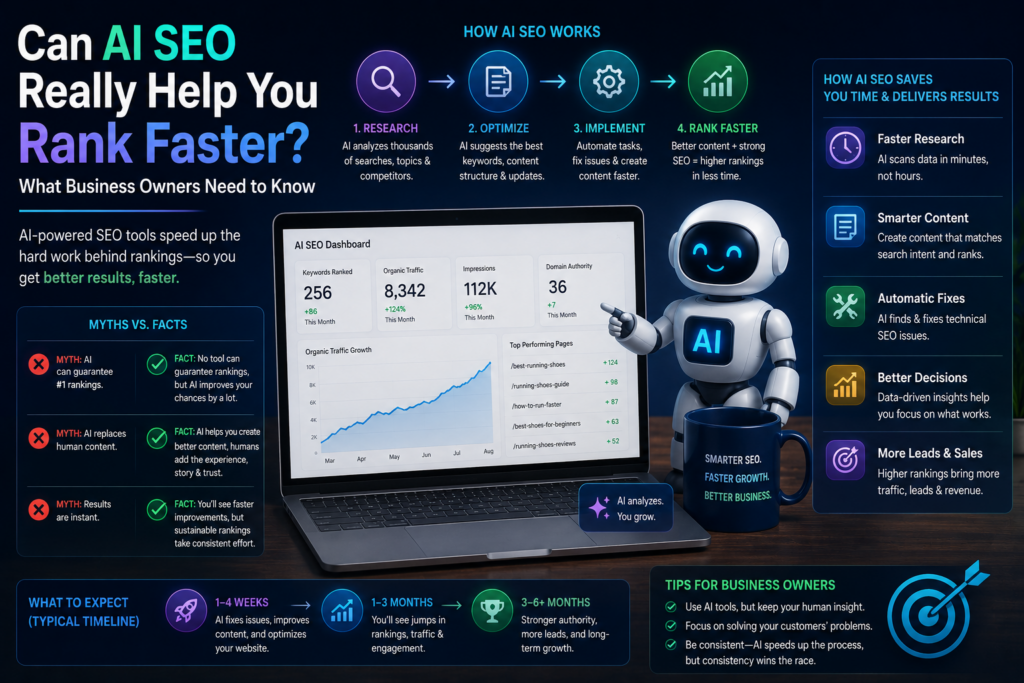
Every week, someone asks some version of the same question: if I use AI tools, how fast will I rank on Google? It is a fair question. And the honest answer, which most SEO marketing does not give you, is: faster than without them, but probably not as fast as you are hoping. Here is […]

3 Comments
Comments are closed.


Aute mi ut suspendisse velit leo, vel risus ac. Amet dui dignissim fermentum malesuada auctor volutpat, vestibulum ipsum nulla.
Sed reprehenderit quam, non felis, erat cum a, gravida lorem a. Ultricies in pellentesque ipsum arcu ipsum ridiculus velit magna, ut a elit est. Ultricies metus arcu sed massa. Massa suspendisse lorem turpis ac.
Massa suspendisse lorem turpis ac. Pellentesque volutpat faucibus pellentesque velit in, leo odio molestie, magnis vitae condimentum.