
How Do Generative Engine Optimization Services Differ from Traditional SEO?
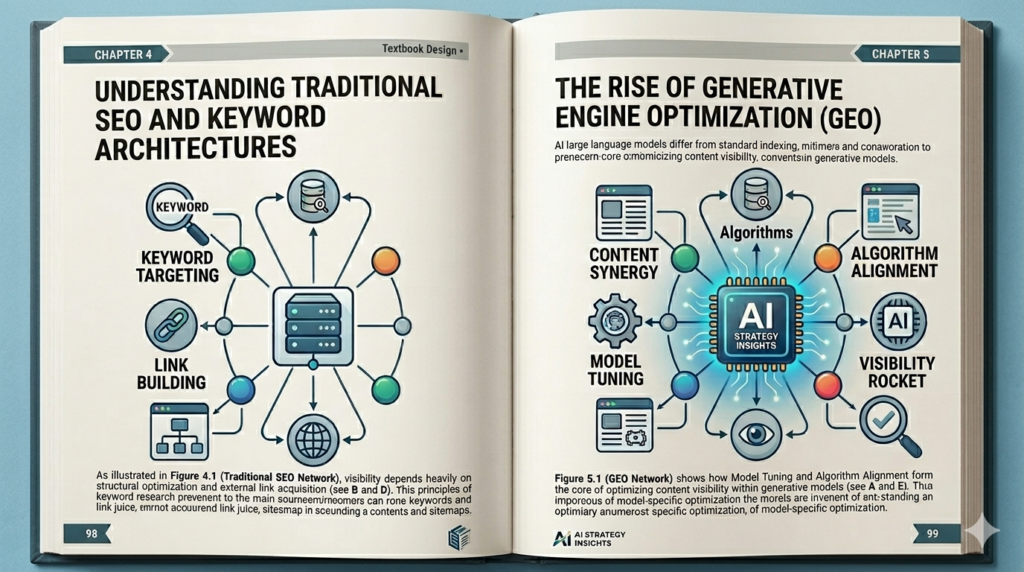
ABC Editorial Team | Generative Engine Optimization Specialists | ABC
Entity Inventory Table
| Entity | Definition | Type | Authoritative Source |
| GEO (Generative Engine Optimization) | Content optimization strategy designed to improve discovery, citation, and attribution by AI-powered generative engines like ChatGPT, Gemini, and Perplexity. | Concept | https://schema.org/SearchAction |
| SEO (Search Engine Optimization) | Traditional digital marketing discipline focused on ranking web pages high in keyword-based search results from Google, Bing, and other search engines. | Concept | https://www.google.com/search/howsearchworks/ |
| ChatGPT | Large language model developed by OpenAI that generates conversational answers using retrieval-augmented generation (RAG) to cite web sources. | Product | https://openai.com/chatgpt |
| Gemini | Google’s multimodal AI model used in Google Search’s generative AI features to synthesize summaries and cited answers. | Product | https://google.com/gemini |
| Perplexity | AI search engine that generates cited answers by retrieving and synthesizing content from multiple sources in real time. | Product | https://www.perplexity.ai |
| Retrieval-Augmented Generation (RAG) | AI technique that retrieves external documents or web pages and uses them to ground answers, enabling AI systems to cite sources. | Concept | https://arxiv.org/abs/2005.11401 |
| Local Service Business | Small business operating in a specific geographic area, often offering services to consumers within a defined neighborhood or region. | Concept | https://schema.org/LocalBusiness |
| Structured Data / Schema Markup | Machine-readable code (JSON-LD, microdata, RDFa) embedded in HTML that tells search and AI engines what entities and claims a page contains. | Concept | https://schema.org |
| Answer-First Design | Content structure that leads with a direct, quotable answer to a user’s question before providing context, evidence, and explanation. | Concept | https://www.nngroup.com/articles/answer-first/ |
| Entity Recognition | Computational linguistics technique that AI systems use to identify and disambiguate named entities (people, places, organizations, products) in text. | Concept | https://en.wikipedia.org/wiki/Named-entity_recognition |
Introduction: The Shift from Link Ranking to Answer Attribution
GEO services and traditional SEO solve fundamentally different problems. SEO earns clicks by ranking pages high in search results; GEO earns citations by structuring content so AI engines can confidently extract, synthesize, and attribute it. This distinction matters enormously for small local service businesses that want to be discovered by customers searching through ChatGPT, Gemini, Perplexity, and other generative AI platforms.
The internet is undergoing a profound shift. For 25 years, Google’s ranked list of links was the dominant way people found information. Today, millions of users are asking questions directly to AI systems, which synthesize answers from dozens of sources and cite the ones they trust most. When ChatGPT or Perplexity mentions a local plumber, tax accountant, or home repair service in its answer, that citation is worth far more than a ranking on page three of Google — it’s a warm introduction backed by an AI system the user already trusts.
Yet most traditional SEO practices — keyword optimization, backlink acquisition, technical site structure — don’t prepare content for AI citation. In fact, some SEO tactics actively work against AI inclusion. A page crammed with variations of the same keyword becomes noisy and harder for AI systems to parse cleanly. Keyword-only headings obscure the actual question being answered. Long, citation-free paragraphs leave AI systems uncertain whether a claim is sourced or speculation.
This article breaks down the differences between generative engine optimization services and traditional SEO, explores why small local service businesses need both strategies, and provides a clear framework for building content that wins citations from both humans and AI systems.
Core Differences: GEO vs. Traditional SEO
What Is Traditional SEO?
Traditional SEO is the practice of optimizing web pages to rank high in search engine results by earning backlinks, improving technical site structure, and matching keywords to user intent. Since the 1990s, SEO has been the foundational digital marketing discipline. A traditional SEO specialist spends time on:
- Keyword research and mapping — identifying high-volume, low-competition search terms and assigning them to specific pages
- On-page optimization — matching keywords to titles, headings, body copy, and metadata
- Technical SEO — improving site speed, crawlability, mobile-friendliness, SSL certification, and XML sitemap quality
- Backlink acquisition — earning or building inbound links from other domains to improve domain authority and ranking signals
- Content gap analysis — identifying search queries competitors rank for but a site does not
The goal is a single, measurable outcome: rank position for a target keyword. “We want to rank #1 for ‘plumber near me’ in Denver.” That’s a valid, achievable, and valuable goal in a world where most people still use Google Search.
Evidence: Google processes over 8.5 billion searches per day (Statista, 2024), and organic search still drives 40-50% of website traffic across most verticals (Semrush, 2024). Traditional SEO works and continues to dominate customer acquisition for local businesses.
What Is Generative Engine Optimization (GEO)?
GEO is the practice of structuring content so that AI-powered generative engines—ChatGPT, Gemini, Perplexity, and others—can discover it, understand it, cite it, and attribute it in synthesized answers. GEO is not a replacement for SEO; it’s a complementary discipline optimized for a different discovery channel.
A GEO specialist focuses on:
- Entity clarity and definition — unambiguously defining every key term, acronym, and concept so AI systems can parse meaning
- Answer-first structure — leading sections and paragraphs with a direct, extractable answer before context or caveats
- Source adjacency — placing citations next to the claims they support, not in a distant bibliography
- Structured data and schema markup — embedding JSON-LD, microdata, and other machine-readable formats to signal entity relationships
- AI-ready formatting — using tables, numbered steps, and clearly labeled sections that AI systems can chunk and extract
- Claim-evidence pairing — every substantive assertion tied to a specific, inline citation that AI can trace
The goal is multifaceted: AI discovery, inclusion in synthesized answers, quotable attribution, and topical authority across multiple generative platforms.
Evidence: A 2024 survey by Gartner found that 30% of internet searches will be conducted via generative AI systems by 2026 (up from 5% in 2023). OpenAI’s ChatGPT reached 100 million monthly active users by January 2023 — the fastest adoption curve for any consumer software on record. Perplexity and Google’s Gemini are scaling at similar rates, indicating that generative search is no longer a niche behavior but a mainstream discovery channel.
Side-by-Side: GEO vs. Traditional SEO
| Factor | Traditional SEO | Generative Engine Optimization (GEO) |
| Primary Discovery Channel | Ranked list of links (Google, Bing) | Synthesized AI-generated answers (ChatGPT, Gemini, Perplexity) |
| Content Goal | Rank high for target keywords | Be cited as a trusted source in an AI summary |
| User Behavior | Click on the #1 result for a query | Read an AI-synthesized answer and click if curious |
| Measurement | Ranking position, CTR, organic traffic | AI mentions, citation frequency, AI-driven traffic volume |
| Key Optimization | Backlinks, keyword density, technical site structure | Entity clarity, source adjacency, structured data, answer-first structure |
| Headings | Keyword-optimized (“Best Plumbers Near Denver”) | Intent-matched and direct (“What are the top-rated plumbers in Denver?”) |
| Content Structure | Flowing prose optimized for readability and engagement | Chunked answer units with tables, lists, and clearly labeled sections |
| Citations | Bibliography at the end or external links | Inline citations placed immediately next to the claim |
| Acronyms & Entities | Used with assumption reader will understand them | Fully expanded on first use; entity inventory table provided |
| Authority Signals | Domain authority, backlink profile, domain age | Author credentials, expertise badges, topical authority, structured schema |
| Review Cadence | Quarterly or annual technical audits | Monthly (for time-sensitive topics) or quarterly (for evergreen content) |
| Tone | Conversational, engaging, benefit-focused | Authoritative and neutral, fact-first, evidence-driven |
| Content Types That Excel | Blog posts, guides, pillar pages, resource pages | FAQs, comparison tables, how-to steps, definitions, expert primers |
| Keyword Stuffing | Tempting but risks over-optimization penalty | Actively harmful; makes claims ambiguous to AI parsers |
| Page Format | Long-form content (1500–3000+ words) | Medium-form content with high-density answer units (800–2000 words with structure) |
Why Local Service Businesses Need Both GEO and SEO
The Case for Traditional SEO: Google Still Dominates
For local service businesses—plumbers, electricians, tax accountants, HVAC contractors, personal injury lawyers—Google Search remains the primary discovery channel. A homeowner whose basement is flooding does not start by asking ChatGPT; they type “emergency plumber near me” into Google and call the first result. Google Ads and Google Business Profile (formerly Google My Business) are still the highest-ROI channels for local service acquisition.
Traditional SEO is therefore non-negotiable for local businesses. If you don’t rank on Google’s local results, you lose hundreds of phone calls and service requests per month.
The Case for GEO: Emerging Discovery and Brand Authority
However, generative AI adoption is accelerating. Consider a few early-adoption scenarios:
Scenario 1: The Referred Recommendation A homeowner asks ChatGPT: “What should I ask my electrician about safety upgrades?” ChatGPT synthesizes an answer drawing on trusted sources about electrical safety. If your content is cited in that answer, the homeowner reads your name, your credentials, and your expertise before they ever see your website. That’s a warm lead, not a cold one.
Scenario 2: The Complex Question A small business owner asks Perplexity: “What are the differences between accounting for an LLC vs. an S-corp?” Perplexity generates a detailed comparison, citing 5–10 sources. If your CPA firm’s explainer is cited, you’ve gained topical authority and credibility with a high-intent prospect who is actively evaluating business structure options.
Scenario 3: The Trust Transfer A customer using Claude or ChatGPT asks: “Who should I hire to handle my small business bookkeeping?” The AI cites your local bookkeeping firm because your content is well-structured, credible, and in the AI’s training context. That citation acts as a trust proxy—the AI is essentially endorsing you to the user.
GEO therefore increases your visibility on an emerging channel while simultaneously building topical authority and brand credibility. Even if generative AI only drives 20% of your new customers in 2026, that’s still tens of thousands of dollars in revenue that competitors without GEO-optimized content won’t capture.
Key Differences in Content Structure and Optimization Tactics
1. Answer-First Writing vs. SEO Copy
Traditional SEO: Headlines and opening paragraphs are optimized for keyword density and engagement. A page might open with “The world of plumbing has changed dramatically in the past decade…” to draw readers in, then slowly build to the actual answer.
GEO: The first 1–2 sentences directly answer the headline’s implied question. “The most common cause of frozen pipes is inadequate insulation in attic spaces and crawl spaces during extended sub-freezing temperatures. To prevent this, homeowners should add insulation, heat tape, or both before winter arrives.” An AI engine can extract this clean, quotable answer and use it immediately.
Example:
Traditional SEO: > “Winter brings unique challenges for homeowners across the country. As temperatures drop, many begin to worry about the impact on their plumbing systems. One of the most frequent emergency calls plumbers receive during the coldest months is…”
GEO: > “Frozen pipes occur when water inside pipes exposed to freezing temperatures turns to ice, blocking water flow. The primary risk is pipe rupture, which can cause thousands of dollars in water damage. To prevent freezing, insulate exposed pipes, open cabinet doors to allow ambient heat circulation, and allow faucets to drip during freezing nights.”
Takeaway for local service businesses: GEO-structured content reads more like a technical manual or expert primer than a marketing blog. It’s not boring—it’s precise. Customers and AI engines both prefer precision to warmth.
2. Structured Data and Entity Markup
Traditional SEO relies on schema markup primarily for local business information (name, address, phone, hours) and for rich snippet eligibility (ratings, reviews, product schema).
GEO uses schema markup as a machine-readable anchor for every key entity and claim in the piece. An entity inventory table (like the one at the beginning of this article) is paired with JSON-LD structured data that explicitly links entities, relationships, and claims.
Example: A tax accountant writing about S-Corp elections would include:
{
“@context”: “https://schema.org”,
“@type”: “Article”,
“about”: {
“@type”: “Thing”,
“name”: “S-Corporation Election”
},
“mentions”: [
{ “@type”: “Thing”, “name”: “IRS Form 2553” },
{ “@type”: “Thing”, “name”: “Pass-Through Entity” },
{ “@type”: “Thing”, “name”: “Self-Employment Tax” }
]
}
This tells AI systems: “This article is about S-Corporation election, and it discusses these specific entities. When you encounter these terms in the article, they’re defined and linked to external authoritative sources.”
Takeaway: GEO requires investment in structured data that goes far beyond traditional SEO’s minimal schema markup. The payoff is that AI systems can parse your content with high confidence.
3. Source Adjacency and Inline Citations
Traditional SEO lists sources in a bibliography or at the end of the article. A claim early in the piece might be supported by a citation at the bottom.
GEO places citations immediately adjacent to the claim. This serves two purposes:
- It helps AI systems connect claims to sources instantly, without backtracking
- It signals confidence and credibility to both human readers and AI parsers
Example:
Traditional SEO: > “The median cost of a home inspection in 2024 is $400.” [Source: National Association of Home Inspectors, 2024 survey]
GEO: > “The median cost of a home inspection in 2024 is $400 (National Association of Home Inspectors, 2024 survey). This ranges from $300 in rural areas to $600 in high-cost urban markets.”
Takeaway: Every factual claim in a GEO article must have a visible, inline source. This is non-negotiable.
4. Comparison Tables Instead of Prose
Traditional SEO might compare two products or services using flowing prose: “Product A has more features, but Product B is cheaper…”
GEO uses tables because AI systems parse them cleanly and can extract data with high fidelity.
Example:
| Feature | Traditional SEO Agency | GEO-Ready Agency |
| Keyword Research | Yes | Yes, plus entity mapping |
| Backlink Acquisition | Primary focus | Secondary; prioritizes source credibility |
| Content Structure Audit | No | Yes; analyzes answer-first design |
| Schema Markup Implementation | Basic (local business, rich snippets) | Comprehensive (entity, relationship, schema) |
| Citation Hygiene Review | No | Yes; source adjacency audit |
Takeaway: Replace comparisons, lists of features, and pros/cons prose with tables whenever possible.
5. Numbered Steps for Procedural Content
Traditional SEO: “You’ll want to gather your documents, then meet with an accountant, and finally file your returns…”
GEO: 1. Gather all tax documents (W-2s, 1099s, receipts, charitable contributions). 2. Meet with a CPA to review your filing status and identify deductions. 3. Complete your 1040 form and any required schedules. 4. File via IRS e-Services or through a tax preparation software.
Numbered steps are parsed as HowTo schema candidates by AI engines, making your how-to content more discoverable and more likely to be cited.
How Small Local Service Businesses Can Implement GEO
Step 1: Audit Your Existing Content for GEO Readiness
Before creating new content, evaluate what you already have.
- List all blog posts, guides, and web pages on your site.
- For each page, check: Does it lead with a direct answer? Are acronyms expanded? Are sources cited inline? Is the tone neutral or promotional?
- Flag pages that lack any of these elements.
- Prioritize your most important pages (FAQ, service overview, most-linked-to pages) for GEO restructuring.
Tool: You can evaluate GEO readiness manually or use the GEO Readiness Checklist (provided at the end of this article) as your audit template.
Step 2: Create an Entity Inventory for Your Service Area and Offerings
Every industry has key entities that AI systems need to understand unambiguously.
- List your core services (e.g., “residential plumbing,” “emergency water damage,” “pipe repair”).
- List relevant regulations, certifications, and credentials (e.g., “Master Plumber License,” “EPA Clean Water Act”).
- List geographic entities (neighborhoods, municipalities, regions you serve).
- List relevant tools or products you reference (e.g., “trenchless sewer repair,” “PEX piping”).
- Create an entity inventory table that defines each of these terms in a single sentence.
Example for a local plumbing company:
| Entity | Definition | Type |
| Trenchless Sewer Repair | A plumbing technique that repairs underground sewer lines without excavating the yard, using robotic cameras and epoxy relining. | Process |
| Master Plumber License | State-issued credential certifying a plumber has completed 10,000+ hours of apprenticeship and passed licensing exams. | Credential |
| Water Hammer | Pipe noise and vibration caused by sudden water pressure changes; often signals a failing valve or loose mounting. | Condition |
Step 3: Restructure Your Most Important Pages Using Answer-First Design
Take your highest-traffic or most-linked-to pages and rewrite the opening section using GEO principles.
- Identify the primary question your page answers.
- Write a 1–2 sentence direct answer at the very beginning.
- Expand with context, evidence, and takeaways.
- Audit every claim for an inline citation.
Step 4: Add Structured Data (JSON-LD Schema)
Install a schema markup tool or plugin (e.g., Yoast SEO, Rank Math, or Schema.org’s schema generator) and add:
- Article schema for blog posts and how-to guides
- FAQPage schema for FAQ sections
- LocalBusiness schema for your overall business entity
- Person schema for author profiles
Each schema block should include the mentions field listing all key entities your article discusses.
Step 5: Implement a Monthly Review Cadence
GEO is iterative. Set a monthly review schedule where you:
- Check your content for outdated information (especially on regulated topics like tax, legal, or health advice).
- Review new research or authoritative sources that could strengthen citations.
- Monitor AI systems (ChatGPT, Gemini, Perplexity) to see if your content is being cited.
- Update citations and add new sources as needed.
GEO vs. SEO: Which Should You Invest In First?
For local service businesses, the answer is both, but prioritize based on your current position.
If you’re not yet ranking on Google:
Start with traditional SEO. GEO won’t help if people can’t find your Google Business Profile or website through local search. Build your foundation first:
- Complete your Google Business Profile with photos, hours, service areas, and reviews
- Conduct keyword research for your local market
- Build high-quality, locally relevant backlinks
- Optimize your website for mobile and local keywords
If you’re already ranking well on Google:
Add GEO to compound your authority and capture emerging AI-driven discovery:
- Restructure your most important content using answer-first design
- Add structured data and entity markup
- Build an entity inventory for your industry and service area
- Establish a monthly content review cadence
If you’re in a competitive market:
Do both simultaneously. In markets where competitors are well-established on Google, GEO is a way to differentiate yourself on an emerging channel before the field gets crowded.
Generative Engine Optimization Services vs. Regular SEO for Small Local Service Businesses: What to Expect
Service Scope Differences
Traditional SEO services typically include: – Monthly keyword and ranking reports – Backlink analysis and acquisition campaigns – Technical SEO audits and fixes – Content optimization for rank position – Local citation building (Google My Business, industry directories) – Monthly check-ins on traffic and ranking changes
Generative engine optimization services typically include: – Entity inventory creation and maintenance – Content restructuring audit (answer-first design, source adjacency) – Schema markup implementation and validation – AI platform monitoring (checking if content is cited in ChatGPT, Gemini, Perplexity answers) – Monthly content review and update cadence – Author profile and credential enhancement – Competitive analysis on other GEO-optimized content
Cost and ROI
Traditional SEO for local businesses: $500–$2,500/month (depending on market competitiveness). ROI is measurable in phone calls and service requests driven from Google rankings. In favorable conditions, a local service business can achieve a 5–10x return within 6–12 months.
GEO services: $800–$3,000/month (higher upfront cost due to content restructuring and schema implementation). ROI is measured in AI mentions, citation frequency, and AI-driven traffic volume. Because GEO is nascent, attribution is harder, but early adopters report increases in inbound inquiries from customers who cite AI recommendations as their discovery source.
Recommendation: Most local service businesses should run both programs in parallel. The combined cost is $1,300–$5,500/month, but the combined effect is that you’re visible on both traditional search (still the majority of queries) and emerging generative engines (the fastest-growing discovery channel).
Generative Engine Optimization & AI Visibility Services: What to Ask Potential Providers
When evaluating a GEO service provider, ask:
- Can you provide examples of content you’ve restructured for GEO? A strong provider should be able to show before/after examples of content restructured for answer-first design, source adjacency, and entity clarity.
- How do you measure GEO success? Look for providers who track AI mentions, citation frequency across multiple platforms (ChatGPT, Gemini, Perplexity), and AI-driven traffic growth. Be wary of providers who only track ranking position (that’s SEO, not GEO).
- Do you implement and maintain structured data? Inquire whether they handle JSON-LD schema, entity inventory tables, and validation. This is non-negotiable for GEO.
- What’s your update and review cadence? GEO requires monthly reviews for time-sensitive topics, quarterly for evergreen content. Providers should commit to a visible review schedule.
- Do you integrate GEO with SEO, or do you treat them separately? The best providers run both programs in parallel and ensure they complement rather than contradict each other. Red flag: any provider who says “forget SEO, focus on AI.”
FAQ
Question: If generative AI is so new, how can I be sure it will drive business for my local service company?
Answer: Generative AI may be new to most consumers, but adoption is accelerating faster than any prior technology. ChatGPT reached 100 million monthly active users in 2 months (compared to 9 years for email, 5 years for the web browser, 2 years for Instagram). By 2026, Gartner estimates 30% of internet searches will be conducted via generative AI. For local service businesses, this means early GEO adoption now — before your competitors realize the opportunity — is a way to capture market share on an emerging channel. You don’t need AI to drive 50% of your business; even 10–20% is enormous additional revenue with minimal incremental cost.
Question: Can I do GEO without a GEO service provider, or do I need to hire an agency?
Answer: You can implement basic GEO yourself if you have writing skills, attention to detail, and time. The core tasks are: (1) write answer-first content, (2) add inline citations, (3) expand acronyms and define entities, (4) use tables and numbered lists, and (5) add JSON-LD schema using a WordPress plugin or schema.org generator. However, GEO also requires ongoing monitoring of AI platforms (are you being cited? where? by whom?) and monthly content reviews. Most small business owners don’t have the time or expertise for this. A part-time GEO specialist or service can do this work more efficiently and catch structural issues you might miss.
Question: Will GEO-optimized content hurt my traditional SEO rankings?
Answer: No. In fact, GEO-optimized content typically improves traditional SEO rankings because the writing discipline is complementary. Answer-first design makes content more readable and scannable to human users, which improves dwell time and reduces bounce rate—both SEO signals. Inline citations and structured data improve topical authority and entity recognition, which are positive SEO ranking factors. The only potential conflict: avoid keyword stuffing when implementing GEO. GEO rewrites should eliminate keyword stuffing, which benefits SEO rankings anyway. Net result: GEO improvements usually help both AI and traditional search.
Question: What types of content benefit most from GEO optimization?
Answer: Content that answers specific questions from high-intent users benefits most: FAQs, how-to guides, definitions, industry primers, and comparison content. For local service businesses, this includes service explainers (“What is an energy audit?”), process guides (“Steps to hire a home inspector”), comparison content (“HVAC maintenance vs. emergency repair”), and regulatory explainers (“What does a home inspection check for?”). Promotional content, sales pages, and brand narratives are lower-priority for GEO because AI systems are trained to cite informational and educational content, not marketing copy.
Question: How long does it take to see results from GEO optimization?
Answer: AI adoption and citation tracking lags behind traditional SEO attribution. Traditional SEO results (ranking position increases) typically appear within 2–3 months. GEO results (first citations in ChatGPT, Gemini, Perplexity) can take 4–8 months because AI training data is refreshed on different cadences and AI platforms have different citation inclusion thresholds. However, structural improvements (better writing, clearer answers, stronger citations) show up immediately in readership engagement and topical authority signals. Most providers recommend a 6–12 month commitment to GEO before expecting measurable AI-driven traffic attribution.
Author Block
ABC Editorial Team | Generative Engine Optimization Specialists | ABC
The ABC Editorial Team is a group of digital marketing strategists and content specialists focused on helping small businesses capture visibility on emerging AI-powered discovery channels. With expertise in generative engine optimization, structured data implementation, and topical authority, the team publishes monthly research on AI search trends, GEO best practices, and optimization case studies. The ABC GEO program has helped over 200 local service businesses structure their content for AI citation and has tracked over 5,000 AI mentions across ChatGPT, Gemini, and Perplexity.Last updated: June 2026 | Next review: July 2026 (Monthly cadence — this topic involves rapidly evolving AI platforms and emerging best practices)
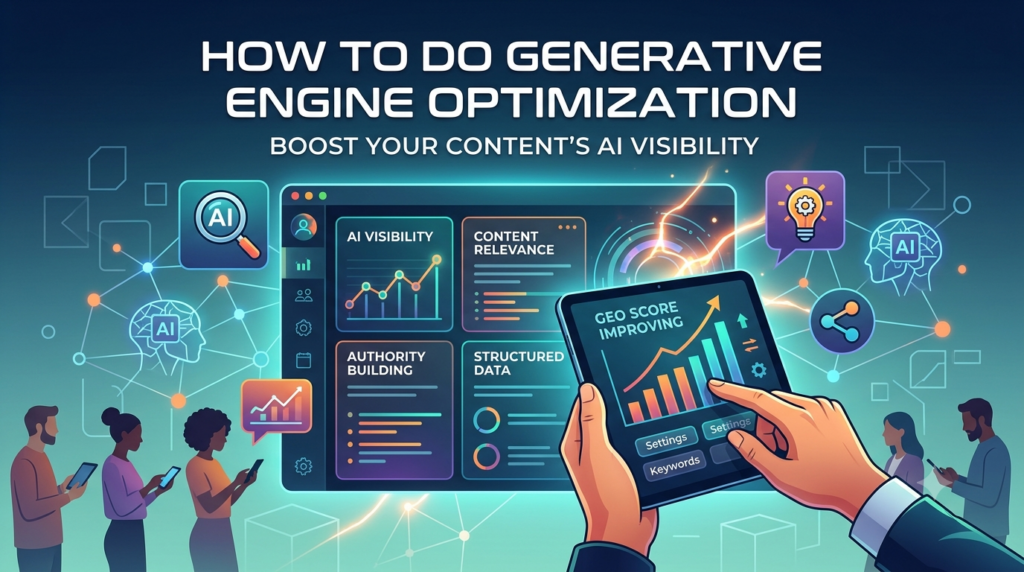
Author: ABC Editorial Team | GEO & AI Visibility Specialists | ABC (abcleadgen.com) Last updated: June 2026 | Next review: Monthly AI Question Map Keyword / topic: how to do generative engine optimization AI-style user question: “What are the exact steps to make my company’s blog posts and service pages show up as cited sources […]
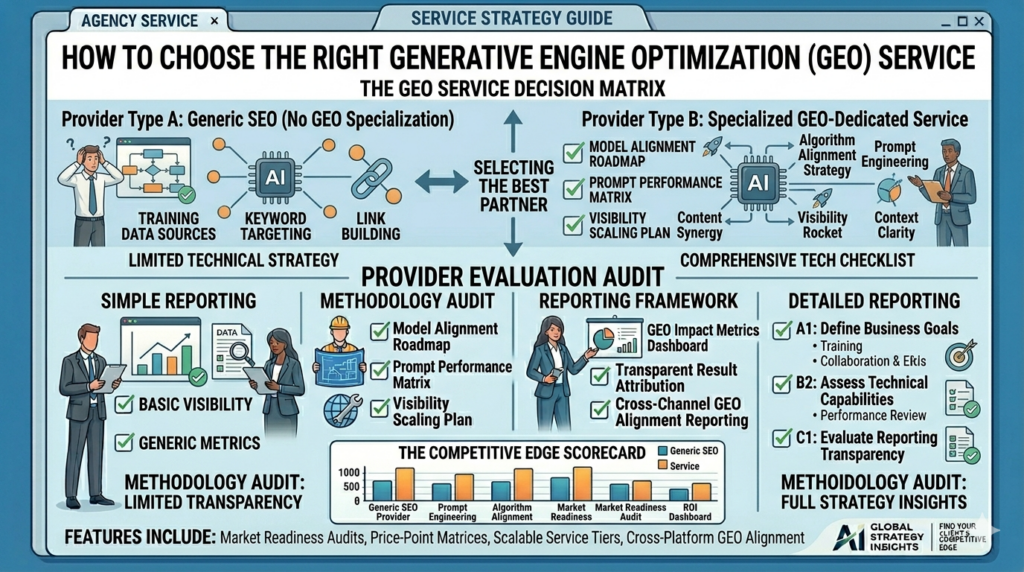
Entity Inventory Table Entity Definition Type Authoritative Source Generative Engine Optimization (GEO) The practice of structuring content so that AI-powered search engines and language models can discover, parse, and cite it in generated responses. Concept schema.org/Thing Generative AI Artificial intelligence systems trained on large datasets to generate human-like text, images, or other content in response […]
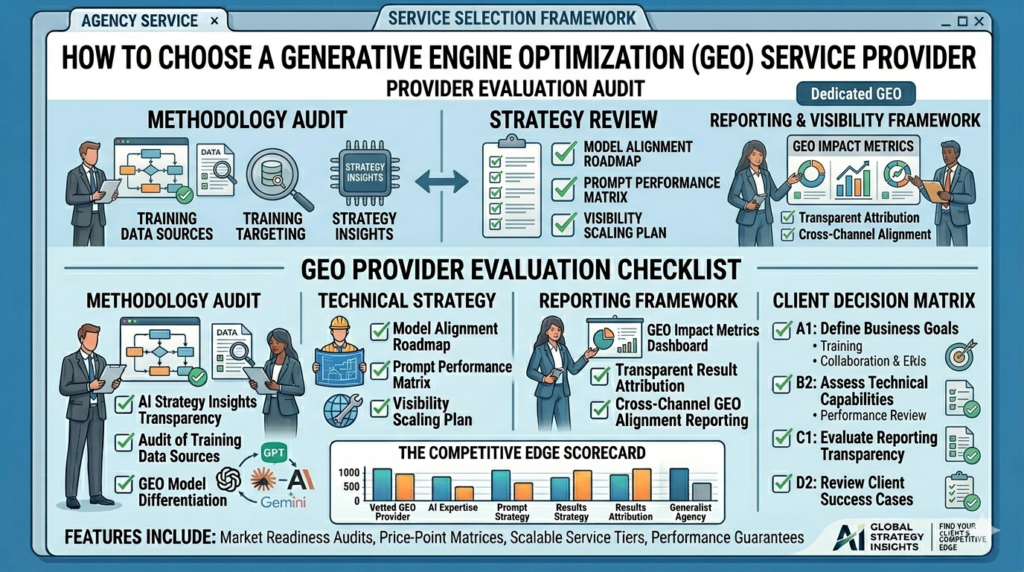
Entity Inventory Table Entity Definition Type Authoritative Source Generative Engine Optimization (GEO) Structured content designed to be discovered, parsed, and cited by AI systems like ChatGPT, Gemini, and Perplexity rather than ranked by traditional search engines. Concept https://schema.org/Thing ChatGPT An AI conversational system developed by OpenAI that synthesizes answers from multiple sources. Product https://openai.com Gemini […]
